Australia's Muslim history starts earlier than most people expect - Makassan fishermen from Sulawesi were trading with Arnhem Land before European settlement, and Afghan and Baluchi cameleers opened the interior in the 1860s, leaving mosques at Marree, Broken Hill and Adelaide. Today around 3.2% of Australians are Muslim, Sydney's Lakemba and Melbourne's Sydney Road are dense halal food districts, and the Ramadan Nights festival on Haldon Street draws well over a million visitors across the month.
Around 3.2% of the population - roughly 800,000 people - with the largest communities in western Sydney and northern and southeastern Melbourne. Certification is handled by several bodies including AFIC, Halal Australia and the ICCV.
Afghan and Baluchi cameleers opened Australia's interior from the 1860s, and their mosques survive at Marree in South Australia, Broken Hill and Adelaide - the Adelaide City Mosque of 1888 is the oldest surviving mosque in an Australian capital.
Haldon Street in Lakemba and Sydney Road in Brunswick are Lebanese and Turkish food districts where almost everything is halal - charcoal chicken, knafeh, pide, mixed grills, and bakeries open until 3am.
Lakemba's Haldon Street closes every night of Ramadan for a street food festival that draws well over a million visitors across the month - the largest Ramadan event in the southern hemisphere, and open to everyone.
The Great Barrier Reef, Uluru, the Great Ocean Road, the Blue Mountains and Kakadu. The natural attractions are the reason to make a long-haul trip.
Sydney, Melbourne, Adelaide and Perth all have substantial Muslim populations, certified restaurants across cuisines, and mosques in most suburbs.
Chips, kebab meat and three sauces in a box - an Australian invention from the kebab shops of western Sydney that became a national phenomenon and has its own review community.
Four days in Sydney including its Muslim west, two at Uluru, three in Melbourne and one for the Great Ocean Road. Internal flights of three to four hours between them.
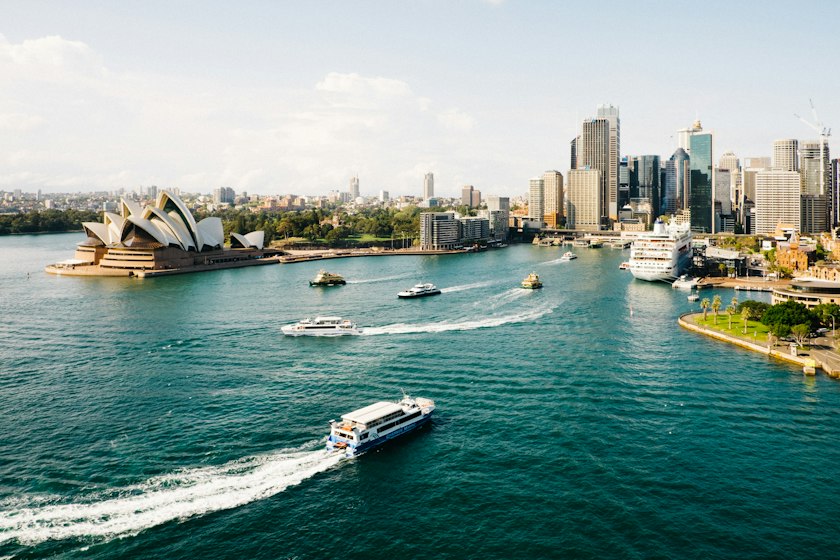
Opera House - Harbour Bridge - The Rocks
Auburn Gallipoli Mosque - Blue Mountains
Bondi to Coogee - Lakemba - Bankstown
Ayers Rock airport - Uluru sunset
Kata Tjuta - Valley of the Winds - Field of Light
Melbourne CBD - laneways - Sydney Road
Islamic Museum of Australia - Preston - St Kilda
Twelve Apostles - Bells Beach - Otways
NGV - Royal Botanic Gardens - Dandenong
Melbourne - or Cairns
Australia has over 300 mosques. The historically significant ones are the cameleer mosques of the 1880s and 1890s in Adelaide, Broken Hill and Marree - among the oldest in the English-speaking world outside Britain.
Built in 1888 by Afghan and Indian cameleers, with four minarets added in 1903. The oldest surviving mosque in an Australian capital city and still in use.
Built by Sydney's Turkish community over two decades and completed in 1999, in classical Ottoman style with Iznik-style tilework and a central dome. Runs open days for visitors.
The largest Muslim congregation in Australia, at the centre of the Lakemba community and the Ramadan Nights festival on Haldon Street.
Built by Afghan cameleers in 1891 in corrugated iron on the edge of the outback mining town, now a museum of cameleer history and one of the oldest mosques in Australia.
The site of the earliest known mosque in Australia, built by cameleers at the railhead in the 1860s and reconstructed on the original site. Marree is where the Birdsville and Oodnadatta tracks meet.
Built in 1905 by Afghan cameleers and Indian Muslims in Northbridge, and still the central mosque of Western Australia's Muslim community.
One of the largest mosques in Victoria, serving the northern Melbourne suburbs, with a community centre and school attached.
One of Melbourne's oldest purpose-built mosques, in the western suburbs, serving a Turkish and Lebanese congregation.
Serving Melbourne's largest Muslim districts, both with attached community centres and halal food streets nearby.
Useful for visitors to the Gold Coast theme parks and beaches, in Arundel, with halal restaurants nearby.
A small mosque serving the tropical north, convenient for anyone visiting the Great Barrier Reef.
The main mosque of the national capital, serving a diverse diplomatic and academic community.
The only Islamic museum in Australia, covering Islamic art and architecture alongside the specifically Australian story - the Makassans, the Afghan cameleers, and post-war migration.
From the 1860s, Afghan, Baluchi and Punjabi cameleers carried supplies across the interior, supported the overland telegraph and the exploring expeditions, and built the first mosques. The Ghan railway is named after them.
Muslim Makassan fishermen from Sulawesi traded with Yolngu communities in northern Australia for at least a century before European settlement, leaving words, rock art and tamarind trees behind.
The 1891 corrugated-iron mosque, restored as a museum with cameleer artefacts, photographs and records. The clearest surviving evidence of that community.
Run by the traditional owners, covering Anangu law, language and creation narratives, and explaining why the climb was closed.
Covers Australia's maritime history including the Makassan trade and the Indian Ocean connections that long predate European settlement.
In the Muslim suburbs of Sydney and Melbourne, halal food is the default rather than the exception - whole streets of Lebanese, Turkish and Afghan restaurants. In the city centres and the regions, it takes planning.
Chips in a box under kebab meat with garlic, chilli and barbecue sauce. Invented in the kebab shops of western Sydney, adopted nationally, and with its own devoted online review community.
Butterflied chicken over charcoal with garlic toum, pickled turnip and flatbread. A Lebanese-Australian institution - El Jannah in Granville is the name.
Shredded pastry over stretchy cheese in syrup, made to order. The Knafeh boys' food truck made it a Sydney phenomenon, and Lakemba's shops do it every night.
Shish taouk, kafta and lamb with hummus, tabbouleh and garlic sauce. The standard family meal across western Sydney.
Boat-shaped baked flatbread with cheese and mince, and thin griddled pastry with spinach and feta. Sydney Road in Brunswick is the address.
Kabuli pulao, mantu and bolani, in Dandenong in Melbourne and Auburn in Sydney - a legacy of both the cameleers and more recent arrivals.
Australian lamb is superb and halal-slaughtered lamb is widely available from certified butchers. A barbecue in a public park is the national pastime and every park has free gas grills.
Melbourne's coffee culture is genuinely world-class and coffee raises no halal question at all. The flat white was invented in Australia or New Zealand, depending on who you ask.
Barramundi, Moreton Bay bugs, prawns and oysters. Fish is straightforward; watch for beer batter in fish and chips.
The two obligatory Australian supermarket purchases. Tim Tams are chocolate biscuits and are halal-friendly; Vegemite is yeast extract and is an acquired taste.
Native ingredients - finger lime, wattleseed, lemon myrtle, kangaroo - are increasingly used in Australian restaurants. Halal-slaughtered kangaroo is available from some certified butchers.
Queensland mangoes in the southern summer are exceptional, and stone fruit from Victoria and South Australia runs from December to March.
Charcoal chicken with garlic toum since 1998, and a genuine western Sydney institution. Queues out the door most evenings; now expanding nationally.
A street of Lebanese bakeries, butchers, sweet shops and restaurants where almost everything is halal. The shops run late and the Ramadan night market closes the street for the whole month.
Long-running Lebanese restaurant in the southwest with a strong reputation for mixed grills and mezze.
Lebanese cooking with several Sydney branches, a step more formal than the charcoal chicken shops.
Auburn Road's Turkish bakeries, pide houses and grills, around the Gallipoli Mosque. Excellent breakfast and very good value.
A long strip of Turkish, Lebanese and Middle Eastern restaurants, bakeries and grocers. Almost all halal, with A1 Bakery and the pide houses the standouts.
Manakish, pastries and a grocery, open early and very cheap. A Melbourne institution.
Afghan, Sri Lankan, Sudanese and Indian restaurants in Melbourne's southeast, serving a large refugee and migrant community. The most varied halal food in Victoria.
The northern suburbs have halal butchers, grocers and charcoal chicken shops on most main streets.
A food truck that made knafeh a phenomenon, with a rotating location and a following. Worth tracking down.
Kebab shops across every Australian city serve the HSP. Standards vary wildly and there is an online community devoted to rating them.
Both tourist regions have a handful of halal restaurants and a mosque - fewer than the southern cities, so check before you go.
Coles and Woolworths carry certified halal meat in areas with Muslim populations, and halal-certified products are clearly labelled.
Adelaide's Hindley Street and Perth's Northbridge, near the historic cameleer mosques, both have halal restaurants and butchers.
Over 300 mosques nationally, concentrated in the Muslim suburbs. Dedicated public prayer rooms are limited outside airports and some universities.
| Where | Prayer facilities |
|---|---|
| Sydney and Melbourne airports | Multi-faith prayer rooms in both international terminals, with ablution facilities. Brisbane and Perth also have them. |
| Mosques | Over 300 nationwide. Sydney's western suburbs and Melbourne's northern and southeastern suburbs have one in most neighbourhoods. |
| Universities | Most Australian universities have a Muslim prayer room, usually open to visitors, which is useful in city centres. |
| Shopping centres | Large centres in Muslim-majority suburbs - Bankstown, Auburn, Broadmeadows, Dandenong - often have prayer facilities. Elsewhere, rarely. |
| Hospitals and public buildings | Most major hospitals have a multi-faith room, and some government buildings do. |
| Hotels | Qibla markers are not standard. Rooms are the usual option; some hotels in the western suburbs cater to Muslim guests. |
| National parks and remote areas | No facilities - carry a mat and use a compass app. Australia is large and empty and this is simply part of travelling here. |
City centres are convenient for sightseeing and poor for halal food; the Muslim suburbs are the reverse. Sydney and Melbourne both have good train links between the two.
Walking distance to the Opera House, the Rocks and the ferries. Halal food requires a 30-45 minute train ride west.
In the middle of the halal food scene, with the Gallipoli Mosque and Haldon Street, at a fraction of CBD prices. Forty minutes by train to the harbour.
Sydney's second centre - good hotels, a large Muslim population nearby, halal restaurants and a 25-minute train or river ferry to the CBD.
The laneways, the galleries, free trams within the centre and trains north to Brunswick and Coburg for halal food.
Sydney Road's Turkish and Lebanese strip, cheaper accommodation and a tram straight into the city.
The resort village is the only accommodation near Uluru, from campground to luxury. Expensive, and there is no halal food - plan accordingly.
The two access points for the Great Barrier Reef and the Daintree. Cairns has a mosque and a few halal restaurants; Port Douglas is quieter and more upmarket.
Theme parks, beaches and high-rise apartments, with a mosque at Arundel and several halal restaurants. Popular with families from Southeast Asia and the Gulf.
Expensive, with internal flights and accommodation the main costs. All figures are per person per day unless stated, excluding international flights.
| Item | Budget | Mid-range | Premium |
|---|---|---|---|
| Accommodation | AUD 100-160 | AUD 220-380 | AUD 700+ |
| Food (3 meals) | AUD 40-70 | AUD 100-170 | AUD 350+ |
| Local transport | AUD 10-20 (Opal/Myki) | AUD 50-100 | AUD 400 (car and driver) |
| Attractions | AUD 0-40 | AUD 80-180 | AUD 400+ |
| Internal flight (one way) | AUD 120-200 | AUD 250-450 | AUD 900+ |
| Daily total per person | AUD 170-270 | AUD 400-700 | AUD 1,600+ |
Southern hemisphere seasons, and a country spanning tropical to temperate - the north and the south have opposite best seasons.
| Period | Weather | Verdict for a halal trip |
|---|---|---|
| September-November | 18-26C in the south | Spring - the best window for Sydney, Melbourne, Adelaide and the Great Ocean Road. Warm, long days and lower prices than summer. |
| December-February | 25-35C in the south | Summer - beach weather, school holidays, peak prices and bushfire risk. The tropical north is in its wet season and is best avoided. |
| March-May | 15-25C in the south | Autumn - excellent in the southern cities, and the tropical north opens up as the wet season ends. |
| June-August | 8-18C south, 22-28C north | Winter in the south, and the best season in Queensland, the Northern Territory and the reef. Uluru is comfortable rather than lethal. |
The questions Muslim travellers ask most often before booking.