Morocco is where Andalusia went after 1492, and it shows: zellij tilework, carved cedar and stucco muqarnas in every madrasa from Fes to Marrakech. All meat is halal, so eating is effortless, and the one real constraint is that working mosques are closed to non-Muslims by a law dating from the French protectorate - with the Hassan II Mosque in Casablanca as the celebrated exception. This guide runs nine days through Marrakech, the Sahara, Fes and Chefchaouen.
Around 99% Muslim, Maliki in school and with a strong Sufi tradition. Everything edible is halal; alcohol is available in licensed hotels and tourist restaurants but is largely invisible in the medinas.
Working mosques are closed to non-Muslims, but the great theological colleges are not. Bou Inania and Al-Attarine in Fes and Ben Youssef in Marrakech are the finest surviving Marinid interiors anywhere.
Al-Qarawiyyin in Fes was founded in 859 by Fatima al-Fihri, a woman, and has run continuously since. UNESCO and Guinness both recognise it as the oldest degree-granting institution on earth.
Built out over the Atlantic in Casablanca, with the tallest minaret in the world, a retractable roof and a glass floor over the sea. One of very few Moroccan mosques that admits non-Muslims, by guided tour.
Every restaurant, stall and butcher is halal. Alcohol exists in licensed hotels and some tourist restaurants but is entirely absent from the medinas and ordinary cafés.
Atlantic surf at Essaouira, the High Atlas above 4,000 metres, the Sahara at Merzouga, and blue-washed Rif mountain towns. All within a long day's drive of each other.
A tagine is MAD 40-80, a riad room MAD 400-900, and a three-day Sahara tour from Marrakech is MAD 1,200-2,500 per person including everything.
A classic loop. Marrakech to Merzouga takes two driving days across the Atlas; from the desert it is a day to Fes, then north to the Rif. Trains link Fes, Rabat and Casablanca; the desert leg needs a car or a tour.
Jemaa el-Fnaa - Koutoubia - souks
Ben Youssef Madrasa - Bahia Palace - Majorelle
Tizi n'Tichka - Ait Ben Haddou - Dades Gorge
Todra Gorge - Merzouga - desert camp
Erg Chebbi sunrise - Ziz Valley - Fes
Bou Inania - Qarawiyyin - Chouara tannery
Rif mountains - Chefchaouen medina
Volubilis - Moulay Idriss - Meknes
Rabat - Casablanca - airport
Working mosques in Morocco are closed to non-Muslims under a rule dating from the French protectorate. Muslims may enter any of them freely. The madrasas - theological colleges, now museums - are open to everyone and contain the best craftsmanship in the country.
Built partly over the Atlantic, with a 210-metre minaret, a retractable roof, heated floors and a glass section through which you can see the sea. Guided tours run several times a day for visitors of any faith. The largest mosque in Africa.
Founded in 859 by Fatima al-Fihri and running continuously since - the oldest degree-granting institution in the world. Non-Muslims can look into the courtyard through the doorways and visit the restored library entrance.
The 12th-century Almohad minaret that set the template for the Giralda in Seville and the Hassan Tower in Rabat. The gardens around it are open to everyone and are the best place to watch the call to prayer at maghrib.
The 1156 Almohad mosque deep in the mountains south of Marrakech - roofless, ruined and open to non-Muslims. It was damaged in the 2023 earthquake; check the restoration status before making the drive.
The unfinished minaret of a 12th-century mosque that would have been the largest in the world, with the columns of the abandoned prayer hall still standing. The mausoleum opposite is open to visitors of any faith.
The tomb of the sultan who built Meknes as an imperial capital, and one of the very few Moroccan shrines that admits non-Muslims.
The shrine of Idris I, founder of the first Moroccan Muslim dynasty and a descendant of the Prophet. The most venerated site in the country; the shrine is closed to non-Muslims but the hill town is open to all.
On the main square beside the kasbah, with an unusual octagonal minaret - a Rif style not seen elsewhere in Morocco.
Founded in 859 alongside Qarawiyyin by refugees from Andalusia, with a monumental 13th-century cedar and zellij gateway that can be admired from the lane.
A small abandoned mosque on the hill opposite the medina, built in the 1920s and never used. Now the sunset viewpoint over the blue town.
The most elaborate Marinid madrasa in the country - carved cedar, stucco muqarnas, zellij and a green-tiled minaret. The water clock on the lane opposite has puzzled engineers for six centuries.
Smaller, at the spice merchants' end of the medina, and if anything finer than Bou Inania. The rooftop gives one of the only clear views over Fes el-Bali.
Once the largest theological college in North Africa, with 130 student cells around a courtyard of marble and zellij. Reopened after a thorough restoration and unmissable.
Stone dye pits worked by hand since the 11th century, best seen from the terrace of one of the leather shops that surround it. They hand you mint for the smell; it does not entirely work.
A fortified mud-brick village stepped up a hillside above a river, continuously maintained for centuries and still partly inhabited. The most photographed place in Morocco after Chefchaouen.
A Roman provincial city with mosaic floors still in place, a triumphal arch and a basilica, on a hillside looking towards Moulay Idriss. Nothing to do with Islamic Morocco, and worth an afternoon anyway.
Everything is halal, and Moroccan food is one of the great cuisines - Amazigh, Arab, Andalusian and Saharan traditions layered over one another. Eat in riads and at street stalls rather than tourist-menu restaurants.
Named after the conical clay pot. Lamb with prunes and almonds, chicken with preserved lemon and olives, kefta with egg. Slow-cooked, and the everyday dish of the country.
Steamed three times over the broth, served with seven vegetables and meat. Traditionally the Friday dish after the midday prayer, which is when to eat it.
Layered warqa pastry over pigeon or chicken with almonds, cinnamon and icing sugar - sweet and savoury at once. A Fassi dish and a celebration one.
Tomato, lentil, chickpea and lamb soup thickened with flour and finished with coriander. The standard iftar opener in Ramadan, eaten with dates and chebakia.
A Marrakech speciality distinct from tagine: meat sealed in a clay urn with preserved lemon and cumin and left in the ashes of the hammam furnace for hours.
Whole lamb slow-roasted in an underground pit oven, sold by weight and eaten with cumin and salt. Mechoui Alley off Jemaa el-Fnaa is the place.
Layered square pancakes and spongy thousand-hole ones, eaten at breakfast with honey, butter and amlou.
Shredded msemen under chicken, lentils and a fenugreek broth. Traditionally cooked for a woman after childbirth, and served at family occasions.
Cooked aubergine and tomato salad, and a roast pepper equivalent. Every meal starts with several small salads like these.
Green gunpowder tea, a great deal of fresh mint and more sugar than you expect, poured from height to aerate it. Refusing it is difficult and unwise.
Argan oil, almonds and honey ground into a spread. Southern Moroccan, and the best thing on any breakfast table.
Sesame-and-honey flower pastries, and a toasted flour, almond and sesame paste. Both are Ramadan foods, made in quantity before the month starts.
Run entirely by women, serving Fassi cooking - the lamb with caramelised pumpkin and the pastilla are the dishes. Book ahead; one of the best restaurants in the country.
A short lane of pit ovens where whole lambs roast overnight. Point at the shoulder, they weigh it, you eat it with bread, cumin and salt standing up. Lunchtime only, until it runs out.
Mechoui and tanjia done properly, in Gueliz and in the medina. Unpretentious and the meat is the point.
Modern Moroccan on a rooftop over the spice square - lighter, more vegetable-forward cooking than the classic riad menu. Alcohol is served; book the terrace.
The original terrace café on the spice square, good for a long mint tea and a sandwich while you watch the souk. Simple and reliable.
A set-menu evening in a restored palace, with a rooftop aperitif and a procession of salads, tagine and pastilla. Theatrical, expensive, and a genuine experience.
Half-day classes in a riad kitchen - the market first, then tagine, bread and salads. One of the better things to do in a city with a lot of shopping.
A cultural café in a restored Fassi house with a camel burger, a sunset roof and a programme of storytelling, Gnawa music and calligraphy classes.
Moroccan small plates in the overgrown courtyard of a collapsed house inside the medina. Mechoui and pastilla must be ordered a day ahead.
A tiny tasting-menu restaurant working with Moroccan ingredients in a modern idiom. Twelve seats, booking essential, and the most ambitious cooking in Fes.
A riad restaurant with a short daily menu and a terrace over the medina. Consistently good and a calm evening after a day in the lanes.
A hundred numbered stalls appear at dusk doing grilled meat, harira, snail soup and sheep's head. Touts are aggressive; pick a busy stall with locals at it and agree what you are ordering.
A small local place off the main square doing tagine and grilled fish at Moroccan rather than tourist prices.
Pick your fish from the morning catch at the harbour stalls and have it grilled in front of you. Agree the price by weight before they cook it.
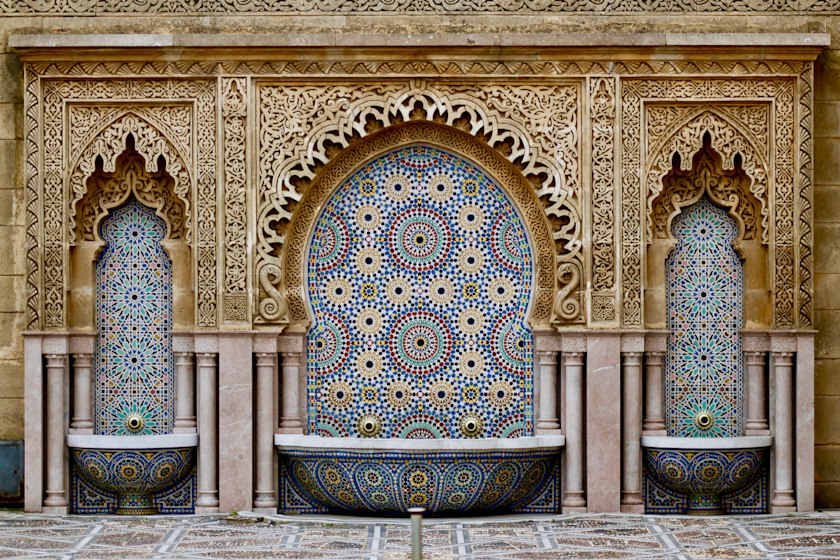
Mosques are everywhere and the adhan from Koutoubia or Qarawiyyin carries across the whole medina. Non-Muslims cannot enter working mosques, but that is no obstacle to Muslim travellers, who may pray in any of them.
| Where | Prayer facilities |
|---|---|
| Any medina | Marrakech and Fes have hundreds of neighbourhood mosques, each with an ablution fountain. You are never more than two or three minutes from one. |
| Casablanca and Marrakech airports | Prayer rooms in every terminal, landside and airside, with ablution facilities. |
| Motorway rest stops | The Casablanca-Rabat-Tangier and Marrakech motorways have service areas with mosques, and the Afriquia petrol stations on main roads have prayer rooms. |
| Train stations | Casa Voyageurs, Rabat Agdal, Fes and Marrakech stations have prayer rooms; the Al Boraq high-speed line stations all do. |
| Riads and hotels | Qibla direction is known to every riad host. Prayer mats are supplied on request and most riads have a quiet corner set aside. |
| Desert camps | All camps have a prayer area and will time dinner around maghrib. Guides carry mats. |
| Souks and markets | Shops in the medina simply close for fifteen minutes at prayer time, particularly for the Friday midday prayer, when much of the medina shuts. |
Stay in riads. A restored courtyard house inside the medina, with six to ten rooms, breakfast on the roof and a host who will arrange everything, is both cheaper and far better than a Ville Nouvelle hotel.
The default and the right choice. Look for one in the Mouassine, Dar el Bacha or Kasbah quarters - quieter than the area immediately around Jemaa el-Fnaa but still walkable to it.
The French-built new town - wide streets, cafés, modern hotels and easier access by car. Less atmospheric, more convenient with luggage or small children.
Spectacular restored houses in the medieval medina, often with rooftops over the whole city. Note that no vehicle can reach them - porters carry luggage the last stretch.
Small family-run houses inside the blue lanes, most with roof terraces facing the Rif mountains. Cheap and almost all alcohol-free.
From shared Berber tents to private suites with plumbing, all in the dunes and all reached by camel or 4x4. Nights are cold October to March.
Converted mud-brick kasbahs on the Marrakech-Merzouga route, with terraces over the gorges. The best overnight stop on the desert drive.
A walled Portuguese-built port with riads inside the ramparts, a long beach and a working fishing harbour. Windy, cool and far more relaxed than Marrakech.
One of the best-value destinations in this guide, particularly for accommodation. All figures are per person per day unless stated, excluding international flights.
| Item | Budget | Mid-range | Premium |
|---|---|---|---|
| Accommodation | MAD 250-450 (riad) | MAD 700-1,400 | MAD 3,000+ |
| Food (3 meals) | MAD 100-180 | MAD 250-450 | MAD 900+ |
| Local transport | MAD 30-60 (petit taxi) | MAD 150-300 | MAD 900 (car and driver) |
| Attractions | MAD 70-150 | MAD 200-400 | MAD 600+ |
| Sahara tour (3 days, pp) | MAD 1,200-1,600 (shared) | MAD 2,000-3,000 | MAD 6,000+ (private) |
| Daily total per person | MAD 400-650 | MAD 1,100-2,000 | MAD 4,500+ |
Four distinct zones: Atlantic coast, interior cities, High Atlas and Sahara, all with different seasons. The spring and autumn shoulders suit all four at once.
| Period | Weather | Verdict for a halal trip |
|---|---|---|
| March-May | 18-28C, green | The best window. Mild in Marrakech and Fes, wildflowers in the Atlas, and the desert still comfortable by day. |
| June-August | 35-45C inland | Marrakech and the desert are punishing. Essaouira and the Atlantic coast stay cool, and the Atlas is the escape. |
| September-November | 20-30C | The other best window - the heat has broken, the light is at its best, and the desert nights are cool rather than cold. |
| December-February | 8-18C, cold nights | Cheapest, and the medinas are quiet. Atlas passes can close with snow and desert nights drop near freezing - pack properly. |
The questions Muslim travellers ask most often before booking.