Islam reached China in the seventh century, and the mosques built by that tradition look like Chinese temples - courtyards, tiled roofs, pavilion minarets, calligraphy that blends Arabic with Chinese brushwork. The Great Mosque of Xi'an has no dome and no visible minaret at all. This guide follows the Hui Muslim heartland: Xi'an's Muslim Quarter, Beijing's Niujie, the Ningxia plain, Linxia in Gansu, and the Song-dynasty Arab trading port of Quanzhou. Halal food - qingzhen - is genuinely everywhere once you know the character.
Between 20 and 25 million Muslims, mostly Hui - Chinese-speaking, Chinese in dress and architecture - alongside Uyghur, Kazakh and other groups. Qingzhen (halal) restaurants are common across northern and western China.
The Great Mosque of Xi'an, founded in 742, is a sequence of Chinese courtyards with a pagoda for a minaret and no dome at all. It is one of the most distinctive expressions of Islamic architecture anywhere.
Hand-pulled beef noodles, roujiamo, big plate chicken and lamb skewers - an entire halal Chinese cuisine that most visitors never encounter, and it is superb.
The Huaisheng Mosque in Guangzhou is traditionally associated with Sa'd ibn Abi Waqqas, a companion of the Prophet. Quanzhou's Qingjing Mosque dates from 1009 and is built in Arab stone rather than Chinese timber.
Linxia in Gansu is called China's Little Mecca, with over eighty mosques in a small city. Ningxia's Tongxin Great Mosque and Najiahu Mosque are working centres of a community almost no foreign visitor reaches.
Forty thousand kilometres of high-speed line. Beijing to Xi'an is four and a half hours, Xi'an to Lanzhou three. Nothing else makes a country this size so easy.
A bowl of Lanzhou beef noodles is CNY 12-18, a good hotel CNY 300-500, and high-speed rail costs a fraction of European equivalents.
The Hui heartland by high-speed rail. Beijing for Niujie, Xi'an for the Great Mosque and the Muslim Quarter, then west into Ningxia and Gansu where the Hui community is densest.
Niujie Mosque - Ox Street - Tiananmen
Forbidden City - Temple of Heaven - Mutianyu
Beijing West - Xi'an - Muslim Quarter
Great Mosque - Terracotta Warriors - Big Wild Goose Pagoda
Muslim Quarter lanes - Shaanxi History Museum
Yinchuan - Najiahu Mosque - Western Xia tombs
Tongxin Great Mosque - Shapotou
Lanzhou - beef noodles - Linxia
Xiahe - Labrang Monastery - Lanzhou
Qingjing Mosque - Huaisheng Mosque
Chinese mosques divide into two traditions: the Chinese temple form, with courtyards, tiled roofs and pavilion minarets, built by the Hui; and the Arab-influenced stone form of the old maritime ports. Both are open to visitors, generally for a small ticket.
Four successive courtyards in Chinese temple form - stone screens, a wooden pavilion serving as the minaret, a prayer hall for a thousand, and Arabic calligraphy rendered in Chinese brush technique. No dome, no arch. One of the most remarkable mosques in the world.
The oldest mosque in Beijing, in Chinese temple style with a 'moon observation tower' in place of a minaret. Two tombs of 13th-century Arab imams stand in the courtyard with their Arabic inscriptions intact.
Traditionally associated with Sa'd ibn Abi Waqqas, a companion of the Prophet said to have led an early mission to China. The Light Tower (Guangta) minaret is a smooth cylindrical stone shaft unlike any Chinese building.
Built in Syrian style in granite by Arab merchants in the Song dynasty's greatest port - a stone gateway and roofless prayer hall entirely unlike the timber mosques of the interior. A UNESCO-listed component of Quanzhou's world heritage.
A Ming-era mosque built on a former Buddhist temple platform, in full Chinese architectural form, and one of the most important centres of Hui religious learning in northwest China.
One of the best-preserved Ming mosques in China, in a Hui village outside Yinchuan, with a five-tier pavilion minaret and painted timber beams.
A Ming-dynasty mosque in central Beijing holding an important collection of Qur'anic manuscripts, including a 14th-century handwritten copy.
Over eighty mosques and Sufi shrines (gongbei) in one small city, spanning Chinese temple form, Central Asian and modern Middle Eastern styles. The densest concentration of Islamic building in China.
The gongbei are domed tomb-shrines of Sufi masters of the Naqshbandi and Qadiri orders, which took root strongly in northwest China. Architecturally distinct from the congregational mosques.
The centre of Yunnan's Hui community, which has its own culinary and historical tradition, including the 19th-century Panthay Rebellion.
The main mosque of Sichuan, in a city otherwise known for its aggressively pork-heavy cuisine - a useful base for halal food in Chengdu.
One of the four great mosques of the southeast coast, rebuilt in the Yuan dynasty, with a prayer hall whose roofline is said to resemble a phoenix.
A network of lanes behind the Drum Tower where the Hui community has lived and traded for over a millennium. Touristy on the main lane, entirely local two streets in.
Hundreds of Arabic-inscribed gravestones from the Song and Yuan dynasties, held in the Quanzhou Maritime Museum - evidence of a large resident Arab and Persian community.
Around 8,000 life-sized figures, each with a distinct face, guarding the tomb of Qin Shi Huang. Not Islamic, and the single most extraordinary archaeological site in China.
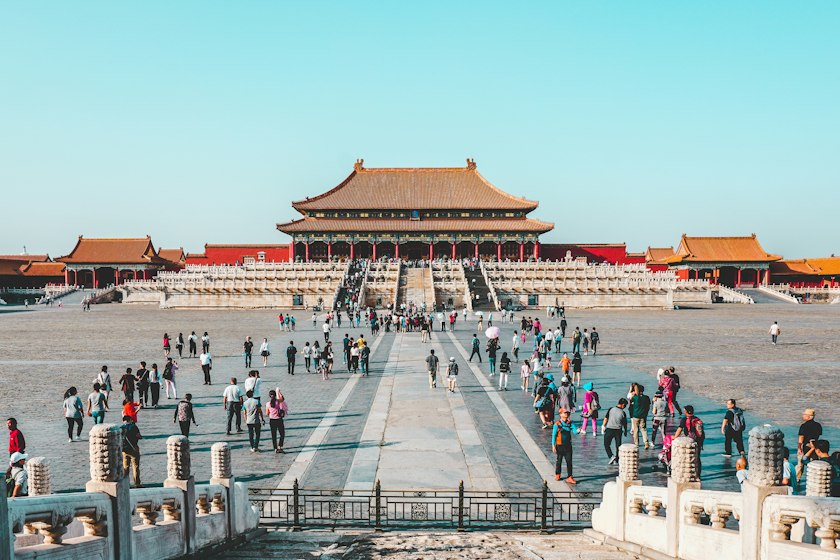
The imperial palace complex, 980 buildings across 72 hectares, seat of the Ming and Qing emperors for five centuries. Book tickets online; daily numbers are capped.
One of the six great Gelug monasteries, with the longest prayer-wheel corridor in the world - and two hours from the Hui city of Linxia, which makes the contrast instructive.
Conical earth mausoleums of the Tangut Western Xia empire, destroyed by the Mongols in 1227 and almost erased from history, standing in the desert below the Helan mountains.
Qingzhen (清真) is the word and the two characters to recognise. Hui cuisine is a complete regional Chinese cuisine in its own right, built on lamb, beef, wheat noodles and cumin rather than pork and rice.
Hand-pulled wheat noodles in a clear beef broth with radish, chilli oil and coriander, made by Hui cooks. Eaten for breakfast. The single best cheap meal in China.
Xi'an's signature dish: you tear a dense unleavened flatbread into small pieces yourself, hand the bowl back, and it returns filled with lamb broth, noodles and meat. Takes twenty minutes to tear properly.
Often called the Chinese hamburger - chopped spiced meat in a griddled flatbread. The Hui version uses beef or lamb rather than the pork of the Han version.
Chicken, potato and peppers in a spiced sauce over wide hand-pulled belt noodles, served on a platter for the table. Xinjiang in origin and found in Hui restaurants across the north.
Cumin lamb skewers over charcoal, the street food of northwest China, sold by the handful from smoking grills in every Hui quarter.
Cold wheat-starch noodles with chilli oil, vinegar, cucumber and gluten pieces. A Xi'an summer staple and usually halal in the Muslim Quarter.
Hand-grabbed rice - lamb and carrot pilaf, the northwest Chinese version of a dish found across Central Asia.
Hui and Uyghur bakers make sesame-studded flatbreads in tandoor-style ovens, sold hot from the street.
Beijing's copper-pot lamb hotpot - thin slices of lamb swirled in clear broth with sesame sauce. Donglaishun and Hongbinlou are the halal institutions.
Ningxia's tea of rock sugar, wolfberry, jujube, longan and chrysanthemum, drunk from a lidded bowl. The Hui hospitality drink.
Xi'an Muslim Quarter sweets - fried persimmon cakes filled with rose and walnut paste, made on the street in autumn.
Goji berries, of which Ningxia produces most of the world's supply, sold dried by the kilo in every market.
A halal restaurant since 1853, doing Beijing-style lamb dishes, hotpot and banquet cooking. One of the best-known qingzhen restaurants in China.
Copper-pot lamb hotpot since 1903, halal, with branches across Beijing. The lamb is sliced paper-thin by hand at the better branches.
Grilled lamb by the lake in Houhai, halal and operating since 1848. Atmospheric and central.
The Ox Street neighbourhood around Niujie Mosque is full of halal butchers, bakeries and small restaurants serving Beijing's Hui community.
Yangrou paomo since 1898 - you tear the bread, they fill the bowl. The benchmark for Xi'an's signature dish.
Soup-filled beef dumplings in the Muslim Quarter, a Xi'an institution with a queue most of the day.
The Muslim Quarter's main lane and the smaller streets behind it - lamb skewers, roujiamo, liangpi, persimmon cakes, hand-pulled noodles. Walk beyond the first two hundred metres.
Hui-run beef noodle shops are in every Chinese city, marked with the qingzhen characters and usually a green sign. CNY 12-18 and open from dawn.
The most famous beef noodle shop in the dish's home city. Go before 10am, as the best shops sell out and close.
A city that is majority Muslim - restaurants around the bazaar serve Hui and Dongxiang cooking to a local rather than tourist clientele.
Ningxia is China's Hui autonomous region; halal restaurants are the default rather than the exception, serving lamb, hand-pulled noodles and eight-treasure tea.
Uyghur-run restaurants in Beijing, Shanghai, Chengdu and elsewhere serve big plate chicken, lamb pilaf and naan, and are halal. Often the easiest option in a southern Chinese city.
Halal restaurants cluster around the Huaisheng Mosque and the Xiaobei district, which has a large African and Middle Eastern trading community.
International hotels in Beijing, Xi'an and Shanghai can usually arrange halal options with notice, particularly those used to Gulf business travellers.
China has roughly 35,000 mosques, overwhelmingly in the northwest. Dedicated prayer rooms at airports and stations are rare, so mosques and hotel rooms are the practical options.
| Where | Prayer facilities |
|---|---|
| Mosques | Around 35,000 nationwide, concentrated in Ningxia, Gansu, Qinghai, Xinjiang and Henan, with historic mosques in every major eastern city. All are open for the five prayers. |
| Hui neighbourhoods | Xi'an's Muslim Quarter, Beijing's Niujie, Linxia, Yinchuan and Lanzhou all have mosques within a few minutes' walk of the halal restaurants. |
| Airports | Prayer rooms are uncommon. Beijing Daxing and a few others have multi-faith rooms; otherwise, use a quiet corner or the hotel before departure. |
| Hotels | Qibla markers are not standard. Use a compass app and carry a travel mat - hotel rooms are the usual answer outside the Hui regions. |
| Xi'an Great Mosque | A working mosque as well as a ticketed monument. Muslims may pray there; visitors pay a small entrance fee outside prayer times. |
| Railway stations | Very large stations occasionally have a quiet room, but dedicated prayer facilities are rare. High-speed trains have quiet carriages. |
| Linxia and Ningxia | In the Hui heartland, mosques are on nearly every street and the adhan is publicly audible - quite unlike eastern China. |
Stay near the Hui quarters - the Xi'an Muslim Quarter, Beijing's Niujie area, and central Yinchuan or Linxia - and the food problem largely solves itself.
Inside the city walls, walking distance to the Great Mosque, the Muslim Quarter and the Drum Tower. The best base in China for a Muslim traveller.
Around the Niujie Mosque and the Ox Street halal shops, on the subway and 20 minutes from Tiananmen.
Walking distance to the Forbidden City and Tiananmen, with the widest hotel choice. Halal food requires a short subway ride to Niujie.
In China's Hui autonomous region, where halal restaurants are the norm. A practical base for Najiahu, Tongxin and the Western Xia tombs.
On the Yellow River, with hundreds of Hui-run beef noodle shops and good rail connections west into the Gansu corridor.
A majority-Muslim city with eighty-odd mosques and almost no foreign visitors. Hotels are basic and the experience is the point.
The Song dynasty's greatest port, UNESCO-listed, with the 1009 Qingjing Mosque and the Islamic tombstones in the maritime museum.
Guesthouses beside Labrang Monastery at 2,900 metres - cold, high and completely different from the Hui towns two hours away.
Very cheap for what you get, with high-speed rail the standout value. All figures are per person per day unless stated, excluding international flights.
| Item | Budget | Mid-range | Premium |
|---|---|---|---|
| Accommodation | CNY 150-280 | CNY 400-700 | CNY 1,500+ |
| Food (3 meals) | CNY 60-110 | CNY 150-280 | CNY 700+ |
| Local transport | CNY 15-40 (metro) | CNY 80-150 (Didi) | CNY 800 (car and driver) |
| Attractions | CNY 40-120 | CNY 200-400 | CNY 800+ |
| High-speed rail (Beijing-Xi'an) | CNY 515 (second class) | CNY 830 (first) | CNY 1,600 (business) |
| Daily total per person | CNY 300-500 | CNY 700-1,300 | CNY 3,000+ |
A continental country the size of Europe - the northwest has severe winters and hot summers, the south is subtropical.
| Period | Weather | Verdict for a halal trip |
|---|---|---|
| April-May | 15-26C | The best window for Beijing, Xi'an and the northwest. Avoid the first week of May for the domestic holiday. |
| June-August | 28-38C | Hot everywhere, humid in the south and east, with the summer domestic travel peak. Gansu and Ningxia are dry and manageable. |
| September-October | 15-27C | The other best window, with clear autumn light. Avoid the first week of October - Golden Week is the busiest travel period on earth. |
| November-March | -10 to 10C in the north | Severely cold in Beijing, Ningxia and Gansu, with the sites at their emptiest and cheapest. Harbin's ice festival is in January. |
The questions Muslim travellers ask most often before booking.