The UAE is the least effortful halal destination in this guide. Meat sold in restaurants is halal by law, pork is confined to licensed sections of a few supermarkets, and every mall, office and petrol station has a prayer room. Sheikh Zayed Grand Mosque in Abu Dhabi is worth the flight on its own; Sharjah has the best Islamic civilisation museum in the Gulf; and Dubai does everything else at scale. Seven days covers all three emirates comfortably.
Emiratis are a minority in their own country - around 11% of residents - but Islam is the state religion, halal is the legal default for meat, and the tourism industry has been built around Gulf and wider Muslim visitors from the start.
Eighty-two domes, the world's largest hand-knotted carpet, chandeliers of Swarovski crystal, and free entry with guided tours in several languages. It is the single most impressive building in the Gulf.
Meat in restaurants is halal by law. You can walk into any restaurant in any mall and order without asking - a freedom that becomes obvious only after travelling somewhere you cannot.
Family rooms, connecting suites, indoor theme parks for the summer, beaches with women-only days, and children welcome everywhere until late. The default holiday shape here is an extended family.
The Museum of Islamic Civilization, the Al Noor Mosque tours and a completely dry emirate - Sharjah is the quiet, serious counterpoint to Dubai twenty minutes away.
Emirates and Etihad connect the UAE to almost everywhere. A stopover of two or three days on the way to or from Asia is the easiest version of this trip.
November to March is 24-30C and effectively rainless, which is why it is the Gulf's peak season and why you book early.
Three days in Dubai, two in Abu Dhabi, one in Sharjah and one for the mountains or the desert. Everything is within a two-hour drive; a hire car or Careem makes it simple.
Al Fahidi - Dubai Creek - Deira souks
Jumeirah Mosque - Burj Khalifa - Dubai Mall
Desert conservation reserve - Marina - Palm
Sheikh Zayed Grand Mosque - Qasr Al Watan
Louvre Abu Dhabi - Saadiyat - Yas
Museum of Islamic Civilization - Al Noor Mosque - Heart of Sharjah
Fujairah or Ras Al Khaimah - airport
Most UAE mosques are for worshippers rather than sightseers, with three important exceptions that run structured tours for non-Muslims: Sheikh Zayed Grand Mosque, Jumeirah Mosque in Dubai and Al Noor Mosque in Sharjah.
Eighty-two domes, 1,000 columns, the largest hand-knotted carpet in the world and seven Swarovski chandeliers. Free entry and free guided tours; abayas lent to women. Book a timed slot online at peak season.
Fatimid-style stone mosque and the only one in Dubai that runs regular guided visits for non-Muslims, six mornings a week through the Sheikh Mohammed Centre. Questions are actively encouraged.
Ottoman in style, on the Khalid lagoon, with guided tours for non-Muslims on set mornings. Sharjah's most photographed building.
Modelled on the Blue Mosque in Istanbul, with 21 domes and blue Iznik-style tiling throughout. Welcomes visitors outside prayer times and has a library and a small museum.
Built around 1446 from mud brick and stone - four small domes resting on a single central pillar, in a room the size of a garage. The oldest mosque in the country and the least like all the others.
Beside the Diwan on the creek, with a 70-metre minaret. Notable for its neighbours - a Hindu temple and a Sikh gurdwara stand on the same lane.
One of the largest mosques in the country, holding around 15,000, in the centre of Sharjah near the Islamic museum.
The second-largest mosque in the UAE, with six minarets and a blue-and-white scheme, on the road into Fujairah city.
A large, clean-lined modern mosque near Bur Dubai, notable for its lighting and its calligraphy programme.
The main mosque for the Marina and JBR district, useful if you are staying on that side of the city.
Astronomy and medicine from the Islamic golden age, Qur'an manuscripts, ceramics and a fragment of the kiswah from the Kaaba, under a golden dome with a zodiac ceiling. The best Islamic museum in the Gulf.
Cultural meals and open-question sessions where Emirati hosts answer anything at all about religion, custom and daily life. Genuinely unusual and genuinely useful.
Jean Nouvel's 180-metre perforated dome creating a 'rain of light' over a museum that arranges objects by period across civilisations rather than by culture.
Restored wind-tower houses, sand-coloured lanes and courtyard galleries, plus the Dubai Museum in the 1787 Al Fahidi Fort. The oldest surviving quarter of the city.
A working presidential palace opened to the public - the Great Hall under a 37-metre dome, the House of Knowledge library, and an evening projection show on the facade.
147,000 date palms irrigated by the 3,000-year-old falaj channel system, with shaded walkways through the plantations. The UAE's first UNESCO World Heritage site.
Emirati cuisine is a small part of what is on offer - the UAE's food scene is really South Asian, Levantine, Iranian and Filipino, all of it halal. Seek out the Emirati restaurants deliberately, because they are outnumbered a hundred to one.
The Emirati version of kabsa - rice cooked in spiced stock with dried lime (loomi), chicken or lamb, and a tomato-based sauce. The national dish.
Wheat and meat pounded together for hours into a smooth savoury paste, topped with ghee. Ramadan and wedding food.
Sweet vermicelli with cardamom, saffron and rose water, served under a thin savoury omelette. Breakfast, and the sweet-savoury combination is the point.
Crisp dough balls soaked in date syrup and sprinkled with sesame. The standard Emirati dessert and the smell of every Ramadan tent.
Saffron and cardamom pancakes served with date syrup and cream cheese. Emirati breakfast, and excellent.
Slightly sweet flatbread cooked on a griddle, eaten with cheese, date syrup or eggs.
Not Emirati, but the UAE does it as well as anywhere - Lebanese chicken shawarma with garlic toum, from a window in Satwa or Deira, for AED 6-12.
Strong tea boiled with evaporated milk, cardamom and a great deal of sugar, sold from drive-through cafeterias for AED 1-2. The national drink in everything but name.
Camel burgers, camel machboos and camel-milk ice cream all exist and are worth trying once. The chocolate made with camel milk is a common gift.
Levantine flatbread with za'atar, cheese or minced lamb, baked to order in the morning. Breakfast across the Arab expatriate community.
The South Asian population is the largest in the country and the Pakistani and Indian food in Satwa, Karama and Deira is exceptional and cheap.
A wafer-thin crepe cooked on a hot plate and filled with cheese, egg and fish paste. Street food from an Emirati regag cart, typically in the evening.
A recreated 1960s Dubai house with sand floors and old radios, serving machboos, harees, balaleet and chebab. The most accessible introduction to Emirati food.
A courtyard of turquoise benches under a tree in the old quarter, doing Emirati breakfast, salads and a long tea list. Exceptionally pleasant in winter.
Modern Emirati cooking in a hotel setting - a refined take on machboos and seafood, with a view over the creek.
Contemporary Emirati in a bright, design-led room. Good for a mall lunch that is not international chain food.
Khaleeji café food done casually - chebab, balaleet, karak. The easy everyday option.
Iranian grills since 1978 in a room papered floor to ceiling with photographs of past customers. Cash, queues, and a Dubai institution.
Pakistani food since 1978, open until 3am, and probably the most famous cheap restaurant in the city. Mutton karahi, dal fry, fresh naan, under AED 40 a head.
Palestinian-Jordanian home cooking by a chef cooking her mother's recipes. Small, warm, and regularly named among the best restaurants in the Middle East.
A fish shack by the beach that grew into an institution - whatever came off the boat, spiced, fried and served with rice and paratha. Queue, then sit outside.
Lebanese shawarma and fresh juice on a corner terrace, open very late. The classic Dubai late-night stop.
The most formal Emirati restaurant in the country, inside the Emirates Palace hotel. Organic local produce, camel, and a serious wine-free approach to fine dining.
The Sharjah branch, in a dry emirate, which makes it a naturally family-focused evening. Al Qasba's waterfront is a short walk away.
Lebanese seafood on the sand looking back at the Dubai Marina skyline. Alcohol is served; the terrace is the draw.
Dense South Indian, Pakistani, Afghan and Filipino eating for AED 15-35 a head. Where the city actually eats.
Prayer rooms are legally required in public buildings and are signposted as musalla or prayer room. Dubai alone has over 2,000 mosques.
| Where | Prayer facilities |
|---|---|
| Dubai and Abu Dhabi airports | Large prayer halls in every terminal, airside and landside, with separate men's and women's sections and ablution facilities. DXB Terminal 3 has several. |
| Shopping malls | Every mall has at least one musalla - Dubai Mall has several on the second floor, Mall of the Emirates and Yas Mall similar. Signposted from the directories. |
| Metro stations and public buildings | The Dubai Metro's larger interchanges, government offices, and most office towers have prayer rooms. |
| Petrol stations and rest stops | ADNOC and ENOC stations on the intercity roads have mosques attached, which makes the Dubai-Abu Dhabi drive simple. |
| Beaches and parks | Public beaches such as Kite Beach and Saadiyat, and the major parks, have prayer rooms near the facilities blocks. |
| Hotels | Qibla markers and prayer mats are standard. Many hotels have a dedicated prayer room; the larger ones broadcast prayer times on the in-room system. |
| Theme parks and attractions | Ferrari World, IMG Worlds, Global Village and the Burj Khalifa all have prayer rooms on site. |
Every hotel in the UAE is Muslim-friendly in practice; the question is whether the property is licensed for alcohol and how family-oriented the surrounding area is. Sharjah removes the question entirely.
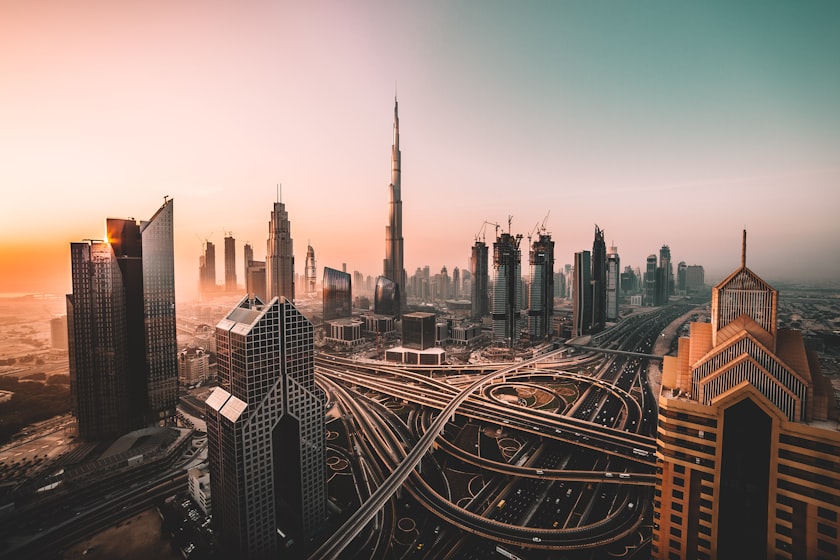
The Burj Khalifa, the Dubai Mall and the fountain on your doorstep, on the metro, and full of family-oriented hotels. The easiest base for a first visit.
Old Dubai - cheaper, denser, better food, and walking distance to the souks and the creek. Many hotels here are unlicensed and therefore alcohol-free.
Beach on one side, restaurants and the metro on the other. Livelier in the evenings, with more bars; good for families who also want the sea.
Sharjah's waterfront district - no alcohol anywhere in the emirate, an evening fountain show, and hotel rates well below Dubai's for the same standard.
The Corniche for the city and the beach walk, Saadiyat for the Louvre, the quietest beaches in the country and the resort hotels.
Cooler, greener and far quieter - the oasis, the camel market and Jebel Hafeet. A different UAE, and a good overnight if you are driving.
Tented camps in the conservation reserves, from basic to luxurious. Most are alcohol-free, all have prayer areas, and the silence is the point.
Expensive by regional standards, but with a very wide range - old Dubai costs a third of what Downtown does. All figures are per person per day unless stated, excluding international flights.
| Item | Budget | Mid-range | Premium |
|---|---|---|---|
| Accommodation | AED 200-350 (Deira/Sharjah) | AED 550-900 | AED 2,000+ |
| Food (3 meals) | AED 60-110 (Karama) | AED 200-350 | AED 700+ |
| Local transport | AED 15-30 (metro) | AED 80-160 (Careem) | AED 600 (car and driver) |
| Attractions | AED 0 (mosques, beaches) | AED 180-400 (Burj, Louvre) | AED 1,000+ |
| Desert safari | AED 150-220 (shared) | AED 350-500 | AED 1,200+ (private) |
| Daily total per person | AED 300-480 | AED 900-1,600 | AED 3,500+ |
Two seasons: a glorious winter and a punishing summer. There is very little in between.
| Period | Weather | Verdict for a halal trip |
|---|---|---|
| November-March | 22-30C, dry | The reason people come. Perfect for beaches, desert and walking. Peak prices, especially over Christmas, New Year and the February half-term. |
| April-May | 30-38C | Warming fast but still workable, with much lower rates than the winter peak. Sea temperature is ideal. |
| June-September | 40-48C, humid | Severe. The beaches are unusable by day and the sea reaches 35C. Cheapest hotel rates of the year and an entirely indoor itinerary. |
| October | 32-38C, easing | The shoulder - heat dropping, rates still low, and the outdoor season reopening towards the end of the month. |
The questions Muslim travellers ask most often before booking.