Halal Travel Guides / Singapore

🇸🇬Halal Travel Guide to Singapore

Singapore has topped the non-OIC rankings in the Global Muslim Travel Index almost every year it has been measured, and it deserves to. Fifteen per cent of the population is Muslim, MUIS certification is displayed on thousands of premises including fast-food chains and hawker stalls, there are over seventy mosques on an island of 730 square kilometres, and prayer rooms are in every mall and MRT interchange. The trade-off is the price - Singapore is expensive, and there is no way around it.

Last updated: 20 September 2026
The Sultan Mosque golden dome rising above the shophouses of Kampong Glam

Why Singapore works for Muslim travellers

Around 15% of Singaporeans are Muslim, mostly Malay. MUIS, the statutory Islamic council, runs one of the strictest halal certification schemes in the world - it will not certify premises that serve alcohol on site.

Muslim population
~15%
Predominantly Malay, with significant Indian Muslim and Arab communities. Islam is one of the recognised religions under Singapore's multiracial framework.
Certification body
MUIS
The Islamic Religious Council of Singapore. Strict - it does not certify premises serving alcohol - and its green certificate is displayed on thousands of shops and stalls.
Language
English
English is the working language, alongside Malay, Mandarin and Tamil. No language barrier at all.
Visa
Visa-free for most
Visa-free for 30-90 days for the GCC, UK, EU, US, Malaysia, Indonesia and most others. An SG Arrival Card must be filed online before entry.
Currency
Singapore dollar (SGD)
Cards and QR payments everywhere; hawker centres increasingly cashless too.
Best months
Feb-April
Equatorial - 26-33C and humid all year. November to January is the wettest; February to April slightly drier.

MUIS certification is everywhere

Over 4,000 certified premises, including whole hawker centres, McDonald's, KFC, Subway and Burger King. MUIS will not certify anywhere serving alcohol, which makes the certificate unusually meaningful.

Seventy mosques on a small island

The Sultan Mosque in Kampong Glam, Abdul Gafoor in Little India, Jamae Chulia in Chinatown and Hajjah Fatimah with its leaning minaret are all within a short MRT ride of each other.

Halal hawker food

Nasi lemak, mee rebus, satay, roti prata, nasi padang and halal-certified chicken rice, in air-conditioned food courts and open-air hawker centres, for SGD 5-9 a plate.

Kampong Glam and Geylang Serai

The historic Malay-Arab quarter around the Sultan Mosque, and the Malay heartland at Geylang Serai, whose Ramadan bazaar draws hundreds of thousands.

Nothing goes wrong

The safest major city in the world, transport that runs to the minute, and an airport that has been voted the world's best more often than any other. For a first trip with family, it is frictionless.

Perfect stopover

Changi is a hub for most of Asia and Australia, with prayer rooms in every terminal and a free city tour for long connections.

Know before you go

Four days in Singapore

One day for Kampong Glam and the mosques, one for Marina Bay and the gardens, one for Sentosa or the zoo, and one for Geylang Serai, Little India and Chinatown. All on the MRT.

1Day

Kampong Glam and the Malay-Arab quarter

Sultan Mosque - Malay Heritage Centre - Haji Lane

morning
Sultan Mosque, the national mosque, with a golden dome ringed by a band of dark glass made from the bases of bottles donated by poorer Muslims so that everyone contributed. Visitors welcome outside prayer times, with robes provided.
afternoon
The Malay Heritage Centre in the former Istana Kampong Glam, then Arab Street for textiles and Bussorah Street for the view back to the mosque dome.
evening
Haji Lane for its shophouse murals and independent shops, then nasi padang at Hjh Maimunah, one of the best-known halal restaurants in the country.
Kampong Glam was the Malay and Arab quarter under the 1822 town plan and has been continuously Muslim since. The whole district is walkable.
2Day

Marina Bay and the gardens

Gardens by the Bay - Marina Bay Sands - Merlion

morning
Gardens by the Bay - the Cloud Forest with its indoor waterfall and the Flower Dome, both worth the ticket, with the Supertree grove outside.
afternoon
The ArtScience Museum, the Merlion and the Marina Bay waterfront loop. The National Gallery in the old Supreme Court is the best museum in the country.
evening
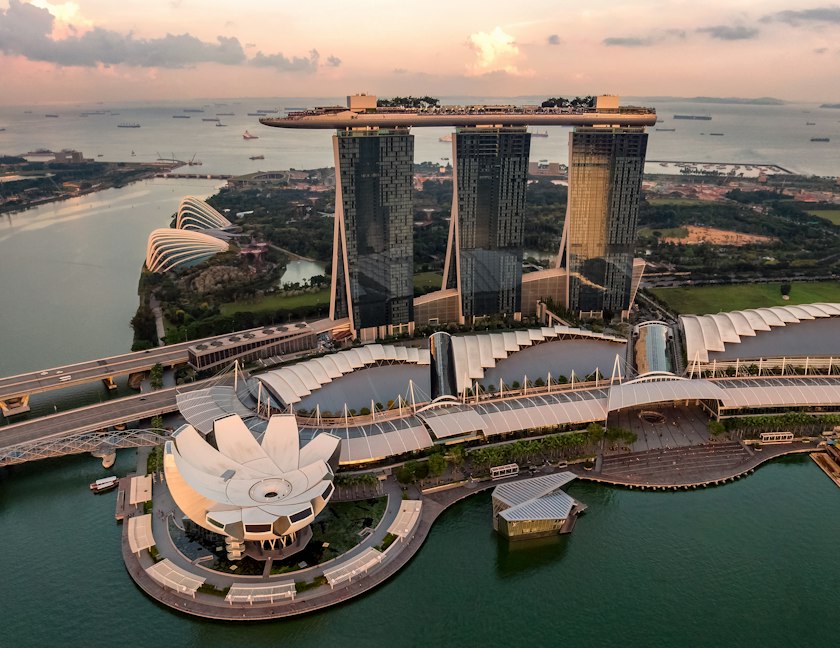
The Spectra light and water show on the Marina Bay Sands waterfront at 8pm, free, then dinner at a halal-certified restaurant in the Marina Bay Link Mall.
Marina Bay Sands and most of the malls have MUIS-certified restaurants and prayer rooms - check the mall directory.
3Day

Sentosa or the zoo

Sentosa - or Singapore Zoo and River Wonders

morning
Sentosa for Universal Studios, the S.E.A. Aquarium and the beaches, or the Singapore Zoo, which is genuinely among the best in the world and is designed as open enclosures rather than cages.
afternoon
The zoo's River Wonders and Night Safari run from the same site; the Night Safari is a tram through nocturnal enclosures and works well with older children.
evening
Back to the city. Lau Pa Sat hawker centre has a halal section and the satay street outside opens in the evening when the road closes to traffic.
Both the zoo and Universal Studios have prayer rooms and MUIS-certified food outlets on site.
4Day

Geylang Serai, Little India and Chinatown

Geylang Serai - Abdul Gafoor - Jamae Chulia

morning
Geylang Serai - the Malay heartland, with a wet market and a hawker centre upstairs that is entirely halal. Not on the tourist trail and much better for it.
afternoon
Little India and Masjid Abdul Gafoor, an 1859 mosque whose sundial gate carries the names of twenty-five prophets in Arabic calligraphy arranged as sun rays. Then the Tekka Centre for biryani.
evening
Chinatown and Masjid Jamae Chulia, built by Tamil Muslim traders in 1826 with a south Indian gateway and a Chinese shophouse setting - a good illustration of how the city works. Fly out of Changi.
Changi's terminals all have prayer rooms and extensive halal-certified dining; Terminal 3 also has a rooftop pool and the Jewel waterfall next door.

Shorter and longer versions

Mosques and Islamic sites in Singapore

Singapore has around seventy mosques, most built or rebuilt under the Mosque Building Fund to which working Muslims contribute monthly. The historic ones are open to visitors outside prayer times, with robes at the door.

Sultan Mosque (Masjid Sultan) Kampong Glam National mosque

Built in 1824 and rebuilt in 1932, with a golden dome ringed by a band of dark glass made from bottle bases donated by poorer Muslims so the whole community contributed. Open to visitors outside prayer times; robes provided.

Masjid Abdul Gafoor Little India 1859

A Tamil Muslim mosque with an extraordinary sundial gate - the names of twenty-five prophets in Arabic calligraphy arranged as the rays of a sun. A national monument and unusually beautiful.

Masjid Jamae (Chulia) Chinatown 1826

Built by Tamil Muslim traders from the Coromandel coast, with a south Indian gateway standing among Chinatown shophouses. One of the oldest mosques in Singapore.

Hajjah Fatimah Mosque Kampong Glam Leaning minaret

Built in 1846 by a Malaccan-born Malay businesswoman, with a European-influenced minaret that leans six degrees off vertical and has done for over a century.

Masjid Malabar Kampong Glam Blue tiles

The Malabar Muslim Jama-ath mosque, clad entirely in lapis-blue tiles, a short walk from the Sultan Mosque. Striking and much less visited.

Masjid Assyafaah Sembawang Contemporary

Opened in 2004 with no dome and no conventional minaret - a modernist reinterpretation in concrete and aluminium that won architectural awards. A very different statement from the colonial-era mosques.

Masjid Al-Abrar Telok Ayer 1855

A small mosque on Telok Ayer Street, which was once the shoreline where immigrants landed - the street also has a Chinese temple and an Indian Muslim shrine within a hundred metres.

Masjid Darul Aman Geylang Heartland

One of the main congregational mosques in the Malay heartland, close to Geylang Serai and its market.

Masjid Sultan's Ramadan bazaar Kampong Glam Seasonal

During Ramadan the streets around the Sultan Mosque fill with stalls, and taraweeh spills out into Bussorah Street.

Masjid Yusof Ishak Woodlands Modern

Named after Singapore's first president, opened in 2017, with an integrated community centre - the current model for Singaporean mosque design.

Islamic heritage and museums

Malay Heritage Centre Kampong Glam Museum

In the former Istana Kampong Glam, the palace of the last Sultan of Singapore, covering Malay settlement, trade, music and the Hajj traffic that once passed through the port.

Kampong Glam Central District

The Malay-Arab quarter designated in the 1822 town plan, with Arab Street, Bussorah Street and Haji Lane, and the Sultan Mosque at its centre. Continuously Muslim for two centuries.

Geylang Serai East Malay heartland

The living Malay district - a wet market, an entirely halal hawker centre upstairs, and the largest Ramadan bazaar in the country.

Indian Heritage Centre Little India Museum

Covers the Indian communities of Southeast Asia including the Tamil Muslim traders who built Masjid Jamae and Abdul Gafoor.

Telok Ayer Street Chinatown Street

Once the waterfront where immigrants landed and gave thanks. A mosque, a Chinese temple, an Indian Muslim shrine and a Methodist church within a few hundred metres.

National Gallery Singapore Civic District Art

In the former Supreme Court and City Hall, holding the world's largest collection of Southeast Asian modern art. The best museum in the country.

What to eat in Singapore - and where

Singapore has the best halal food scene of any non-Muslim-majority country. MUIS certification is displayed on over 4,000 premises, including whole hawker centres and every major fast-food chain.

Dishes worth planning a day around

Nasi lemak

Coconut rice with sambal, fried anchovies, peanuts, egg and fried chicken. The Malay breakfast, available all day at halal hawker stalls.

Mee rebus

Yellow noodles in a thick sweet-spicy sweet potato gravy with egg, tofu and lime. Singaporean Malay, and found almost nowhere else.

Mee siam

Rice vermicelli in a sour-sweet tamarind gravy with egg and beancurd puffs. Another dish specific to the Malay Singaporean kitchen.

Nasi padang

Minangkabau cooking served from a display counter - rendang, ayam bakar, sambal goreng. Hjh Maimunah is the benchmark.

Satay

Chicken, beef or mutton skewers with peanut sauce, ketupat and onion. The satay street outside Lau Pa Sat opens in the evening when the road closes.

Roti prata

Flaky flatbread cooked to order with curry, from 24-hour Indian Muslim prata shops. The classic late-night meal.

Murtabak

Prata stuffed with spiced minced mutton and onion, folded and griddled. Zam Zam in Kampong Glam has been making it since 1908.

Halal chicken rice

Hainanese chicken rice is the national dish and several MUIS-certified stalls do it properly - poached chicken, rice cooked in the stock, chilli and ginger.

Biryani

The Tekka Centre and the Dunlop Street shops in Little India do excellent Indian Muslim biryani, dum-cooked and served with brinjal curry.

Laksa

Rice noodles in a coconut curry broth with prawns and cockles. Halal-certified versions are widely available.

Teh tarik and kopi

Pulled milk tea, and Singaporean coffee ordered in a dialect of its own - kopi-o, kopi-c, kopi siew dai. Learn two or three phrases.

Kuih and ondeh-ondeh

Malay sweets - layered kuih lapis, pandan-scented ondeh-ondeh with palm sugar inside. Geylang Serai market is the place.

Restaurants

Hjh Maimunah Jalan Pisang, Kampong Glam MUIS certified

Nasi padang from a long counter of Malay and Minangkabau dishes - beef rendang, sambal goreng, ayam bakar. Probably the best-known halal restaurant in Singapore. Queue at lunchtime.

Zam Zam Restaurant North Bridge Road MUIS certified

Murtabak and biryani since 1908, opposite the Sultan Mosque, with the cooks working the griddle in the window. An institution.

Islamic Restaurant North Bridge Road MUIS certified

Serving nasi briyani since 1921 and reputedly the oldest Muslim restaurant in Singapore. Its dum biryani is the reason to go.

Warong Nasi Pariaman North Bridge Road MUIS certified

Padang food since 1948, a few doors from the Sultan Mosque, and a fierce local favourite. Lunchtime only, and it sells out.

Sabar Menanti Kandahar Street MUIS certified

Another long-running nasi padang counter in Kampong Glam, with excellent beef rendang and ayam lemak.

Geylang Serai Market food centre Geylang Serai MUIS certified

An entirely halal hawker centre above the wet market - mee rebus, nasi lemak, satay, lontong. Where Malay Singapore actually eats and far cheaper than the tourist areas.

Tekka Centre Little India MUIS certified stalls

A large hawker centre with a strong cluster of Indian Muslim stalls doing biryani, murtabak and mutton soup. Check each stall's certificate.

Bismillah Biryani Dunlop Street, Little India MUIS certified

Dum-cooked Hyderabadi-style biryani in a small shophouse, widely considered the best in the city.

Springleaf Prata Place Several branches MUIS certified

Roti prata done well, including inventive versions, with long opening hours. A reliable breakfast anywhere in the city.

Arnold's Fried Chicken Several branches MUIS certified

A Singaporean halal fried chicken institution, useful when travelling with children.

Lau Pa Sat and the satay street Raffles Place Mixed - check stalls

A Victorian cast-iron market building with a halal section, and satay stalls that set up outside when Boon Tat Street closes at 7pm.

Hajah Mona Nasi Padang Bedok MUIS certified

A heartland nasi padang institution away from the tourist districts, with the queue to prove it.

Positano Risto Bussorah Street MUIS certified

Halal-certified Italian in Kampong Glam - evidence of how far Singapore's certified scene reaches beyond Malay and Indian food.

Fast-food chains Nationwide MUIS certified

McDonald's, KFC, Burger King, Subway, Texas Chicken and Mos Burger are all MUIS-certified across Singapore - useful, and unusual outside Malaysia.
Watch out for:
  • Most restaurants are not halal. Pork is central to Chinese Singaporean cooking and lard is used in many otherwise vegetarian noodle dishes. Look for the MUIS certificate.
  • 'No pork, no lard' signs are common and are not certification - they say nothing about the meat supplier or the kitchen.
  • Mixed hawker centres have halal and non-halal stalls side by side, with shared seating. Certified stalls display the MUIS logo; halal cutlery is usually kept separate.
  • Chicken rice, laksa and char kway teow exist in both halal-certified and non-halal versions - check the stall rather than the dish.
  • MUIS does not certify premises that serve alcohol, so a certified restaurant is always alcohol-free.

Prayer, dress and practicalities

Prayer rooms are in every mall, every MRT interchange and at every major attraction, and there are around seventy mosques on the island.

WherePrayer facilities
Changi AirportPrayer rooms in all four terminals, airside and landside, with ablution facilities. Jewel Changi also has one. Extensive halal-certified dining throughout.
Shopping mallsMost large malls have a prayer room - check the directory or ask at concierge. Bugis Junction, VivoCity, Jewel and the Marina Bay malls all do.
MosquesAround seventy across the island, all open for the five prayers. Sultan, Abdul Gafoor, Jamae and Hajjah Fatimah are all central and welcome visitors.
AttractionsThe Singapore Zoo, Universal Studios, Gardens by the Bay, Sentosa and the Science Centre all have prayer rooms on site.
MRT interchangesSeveral larger interchange stations have prayer facilities; the MuslimSG and HalalGo apps map them along with certified restaurants.
HotelsQibla markers and prayer mats are available on request at most hotels; several in Kampong Glam and Bugis cater specifically to Muslim visitors.
Universities and public buildingsPrayer rooms are common in public institutions - Singapore's multiracial policy means they are planned in rather than added later.

Practical notes

Where to stay in Singapore

Where you stay determines how easily you eat. Kampong Glam and Bugis put you in the middle of the halal restaurant scene; Marina Bay is the view and the price.

Kampong Glam and Bugis Central Best for halal food

The Malay-Arab quarter, with the Sultan Mosque, Arab Street and a dozen of the country's best halal restaurants within walking distance. On the MRT and cheaper than Marina Bay.

Little India Central Value

Cheapest central accommodation, with Masjid Abdul Gafoor, the Tekka Centre and the Dunlop Street biryani shops. Busy and characterful.

Marina Bay Central Premium

The waterfront hotels with the skyline views, the Gardens and the malls. Expensive, and further from the halal food clusters.

Orchard Road Central Shopping

The shopping belt, with hotels at every price and prayer rooms in most of the malls. Convenient rather than atmospheric.

Geylang and Paya Lebar East Heartland

Near Geylang Serai and its entirely halal hawker centre, at heartland rather than tourist prices. Note that parts of Geylang are a red-light district - check the exact street.

Sentosa Island Resort

Resort hotels on the island with the beaches, Universal Studios and the aquarium. Good with children, expensive, and cut off from the city's food.

Changi and Jewel East Transit

Airport hotels including one inside Jewel, useful for very early flights or long layovers.

Beaches, pools and leisure

What a halal-friendly trip to Singapore costs

One of the most expensive destinations in this guide, with hawker food the notable exception. All figures are per person per day unless stated, excluding international flights.

ItemBudgetMid-rangePremium
AccommodationSGD 90-150SGD 200-350SGD 700+
Food (3 meals)SGD 20-35 (hawker)SGD 60-110SGD 250+
Local transportSGD 6-12 (MRT)SGD 30-60 (Grab)SGD 200 (private car)
AttractionsSGD 0-30SGD 60-130 (zoo, Gardens)SGD 300+ (Universal, aquarium)
Day on Sentosa (pp)SGD 20-40SGD 90-150SGD 300+
Daily total per personSGD 130-200SGD 300-520SGD 1,200+

Best time to visit Singapore

Equatorial and one degree north of the equator - 26-33C and humid every day of the year. What varies is the rain and the haze.

PeriodWeatherVerdict for a halal trip
February-April26-33C, slightly drierThe best window, marginally. Less rain and the clearest skies of the year.
May-July27-33C, hotThe hottest months, with afternoon thunderstorms. School holidays make the attractions busy in June.
August-October26-32C, possible hazeOccasional haze from regional land clearing can affect air quality for days at a time. The Formula 1 night race is in September.
November-January25-31C, wettestThe northeast monsoon brings the heaviest rain, usually in short intense bursts. Christmas on Orchard Road is a genuine event.
Travelling during Ramadan: Singapore's Ramadan is centred on the Geylang Serai bazaar, which runs the whole month with several hundred stalls and draws hundreds of thousands of visitors of every faith. The streets around the Sultan Mosque in Kampong Glam are lit and filled with stalls, and taraweeh spills into Bussorah Street. Nothing closes during the day - Singapore is religiously mixed and business continues normally - so a Ramadan visit costs you nothing and gains you one of the best food markets in Southeast Asia. Hari Raya Aidilfitri is a public holiday and the heartland districts hold open house.

Singapore halal travel FAQ

The questions Muslim travellers ask most often before booking.

How reliable is MUIS certification?
Very. MUIS is a statutory board, audits the supply chain rather than just the kitchen, and will not certify any premises that serves alcohol. Over 4,000 outlets hold the certificate, including whole hawker centres and the major fast-food chains. The green logo is displayed prominently and is checkable on the MuslimSG app.
Is it hard to eat halal in Singapore?
No - it is the easiest non-Muslim-majority country in the world for it. The caveat is that the majority of restaurants are still not certified, because pork and lard are central to Chinese Singaporean cooking. You look for the certificate rather than assuming, and there are thousands of certified options.
What does 'no pork, no lard' mean?
It means the kitchen does not use pork or lard. It does not mean the meat is from a halal supplier, and it is not MUIS certification. Many Muslim Singaporeans accept these venues; many do not. Certified premises display the green MUIS logo with a certificate number.
Can I share a table at a mixed hawker centre?
Yes, and it is normal - seating is communal and not segregated. Certified stalls keep their own crockery and utensils, and trays from halal stalls are returned to marked racks. If it concerns you, Geylang Serai's hawker centre is entirely halal.
Is Singapore worth more than a stopover?
Three or four days is right for a first visit - Kampong Glam, Marina Bay, the zoo and the food. With children it easily stretches to six. Beyond that the cost starts to tell, and Malaysia is across the causeway.
Where should I stay for the best halal food?
Kampong Glam or Bugis. Hjh Maimunah, Zam Zam, Islamic Restaurant, Warong Nasi Pariaman and Sabar Menanti are all within a few minutes' walk of the Sultan Mosque, and it is cheaper than Marina Bay.
Are there prayer rooms at the attractions?
Yes - the zoo, Universal Studios, Gardens by the Bay, Sentosa, most malls and all four Changi terminals have them. The MuslimSG app maps them, along with the nearest mosque and the prayer times.
How expensive is it really?
Hotels are the problem - SGD 200-350 for a mid-range room. Everything else is manageable: hawker food is SGD 5-9 a plate, the MRT is a couple of dollars, and several of the best things (Kampong Glam, East Coast Park, the mosques, the Marina Bay light show) are free.