Taiwan has fewer than 100,000 local Muslims but has spent a decade building halal infrastructure deliberately - prayer rooms in train stations, at the National Palace Museum, at Taipei 101 and at Sun Moon Lake, and a national certification programme through the Chinese Muslim Association. The result is a country that consistently ranks among the best non-OIC destinations in the Global Muslim Travel Index. Add night markets, a mountain spine reaching 3,900 metres, and some of the friendliest people in Asia.
Around 60,000 Taiwanese Muslims plus roughly 250,000 Indonesian migrant workers. The Chinese Muslim Association runs the certification scheme, and the tourism bureau has actively funded prayer rooms and restaurant certification.
Taiwan's tourism bureau funded prayer rooms at Taipei Main Station, Taoyuan Airport, the National Palace Museum, Taipei 101, Sun Moon Lake, Kenting and dozens of other sites. Very few countries have done this deliberately.
Taiwan's national dish, in halal form, from Hui Muslim restaurants that have been making it for generations. The Longgang Yunnanese Muslim community near Taoyuan is the other great food story.
The Chinese Muslim Association certifies hundreds of restaurants and hotels, and the tourism bureau publishes and promotes the list. Muslim-friendly hotel ratings are standardised.
Taroko Gorge, a marble canyon cut by a river; Alishan's cloud sea; and 268 peaks over 3,000 metres on an island the size of the Netherlands.
A good Taipei hotel is TWD 2,500-4,500, a night market dinner TWD 150-300, and the high-speed rail crosses the island in 90 minutes.
Taiwan has a genuine reputation for hospitality to visitors - people will walk you to where you are going rather than point. It makes the language barrier much less of an issue.
Three days in Taipei, one on the northeast coast, two for Taroko and Hualien, one for Sun Moon Lake. High-speed rail down the west, regular trains up the east.
Taipei Grand Mosque - Da'an - Taipei 101
National Palace Museum - Dadaocheng - Ximending
Jiufen - Shifen - Yehliu
Longgang Mosque - Zhongli - Taoyuan
Hualien - Taroko - Qingshui Cliffs
Sun Moon Lake - Wenwu Temple - cycling
Taichung - or Tainan - Taoyuan Airport
Taiwan has seven or eight mosques, most built by Chinese Muslim communities who arrived with the Kuomintang in 1949. All welcome visitors and are used to explaining themselves.
Built in 1960 with funding from Saudi Arabia, Jordan, Kuwait and others, designed by the architect Yang Cho-cheng. A municipal heritage building and the centre of Taiwan's Muslim community. Visitors welcome outside prayer times.
Built in 1964 by Chinese Muslim soldiers from Yunnan who retreated through Burma and Thailand after 1949. The community around it still cooks Yunnanese Muslim food, and this is the best halal eating on the island.
A smaller mosque in Wenshan district, serving the southern part of the city, with a community centre attached.
Serving the substantial Muslim community in central Taiwan, including many Indonesian workers, with an attached halal shop.
The main mosque of southern Taiwan, rebuilt in 1992, serving both the local Hui community and migrant workers in the port city.
A small mosque in the historic capital, serving a modest local congregation.
A small prayer facility on the east coast, useful for anyone visiting Taroko Gorge.
Beyond the mosques, Taipei Main Station, Taipei 101, the National Palace Museum and several department stores all have dedicated prayer rooms.
The imperial Chinese collection evacuated from Beijing in 1948 - close to 700,000 objects including bronzes, jade, calligraphy and porcelain. Has a prayer room and halal options on site.
A settlement of Chinese Muslims from Yunnan who fought their way out of the mainland through Burma and Thailand after 1949, with a mosque, a street of restaurants and a distinct cuisine.
The 19th-century tea and medicine trading district, with restored shophouses, dried goods shops and the Xiahai City God Temple.
A former gold-mining town of stepped lanes and red lanterns above the Pacific, and one of the most atmospheric places in Taiwan when it is not full.
The Dutch fort of 1624 and the temples of Taiwan's first capital - the island's deepest historical layer.
A marble canyon cut by the Liwu river, with tunnels, suspension bridges and trails. Badly damaged by the 2024 Hualien earthquake - check current access.
Taiwan's national dish, beef noodle soup, has excellent halal versions made by Hui Muslim families. Beyond that, the Yunnanese Muslim community at Longgang is the island's real halal food story.
Taiwan's national dish - braised beef shank in a spiced soy broth with hand-pulled noodles and pickled mustard greens. The Hui Muslim restaurants near the Taipei Grand Mosque make the best of it.
Guoqiao mixian, crossing-the-bridge noodles, in the Longgang Muslim community's version - rice noodles in a rich broth with thin slices of beef cooked in the bowl.
Taiwanese hotpot is a national obsession, and several halal-certified hotpot restaurants operate in Taipei with beef and lamb broths.
Braised beef, scallion and hoisin rolled in a flaky scallion pancake. A Chinese Muslim dish in origin and available halal.
Steamed buns, filled with beef and vegetables in the halal versions from Muslim bakeries near the mosques.
Cold dishes from the Longgang community - pea-flour jelly with chilli and vinegar, and a spicy cold noodle salad. Found nowhere else in Taiwan.
Invented in Taichung in the 1980s. Milk tea with tapioca pearls - check for gelatine in the jelly toppings, but the standard pearls are tapioca starch.
Mountains of ice with mango, condensed milk, red beans and taro. Almost always fine, and essential in summer.
Taiwan grows superb mango, pineapple, wax apple, lychee and custard apple. Night market fruit stalls are a highlight.
Layered flatbread with spring onion, griddled and folded, often with egg. Street food, and usually vegetarian - check the frying oil.
Taiwan's 250,000 Indonesian workers support a network of halal Indonesian shops and restaurants, especially around Taipei Main Station on Sundays.
Night markets are mostly not halal, but individual certified stalls exist - the tourism bureau's halal list marks them.
Halal beef noodle soup near the Taipei Grand Mosque, run by a Hui Muslim family. The classic Taiwanese dish in a form you can eat.
Several halal beef noodle shops cluster on and around Xinsheng South Road - this is the densest halal street in Taipei.
Yunnanese Muslim cooking in the Longgang community - rice noodles, cold pea jelly, braised beef. The best halal food on the island and worth the 40-minute trip from Taipei.
A street of Yunnanese and Burmese Muslim restaurants and tea shops beside the mosque, serving a community with its own distinct cuisine.
Long-running halal Indian restaurant in central Taipei, reliable and popular with the local Muslim community.
Turkish grills and mezze, one of several Turkish restaurants that serve as a dependable halal default in the capital.
Nepali and Indian cooking, halal, near the city centre.
Several certified hotpot restaurants operate in Taipei, which matters because hotpot is the Taiwanese social meal.
The area north of Taipei Main Station fills with Indonesian shops and food stalls, busiest on Sundays when migrant workers have their day off. Cheap, halal and entirely authentic.
A certified restaurant in the Taipei 101 mall, with a prayer room on the 35th floor - the tourism bureau's Muslim-friendly programme in practice.
Taiwan operates a standardised Muslim-friendly hotel rating; certified hotels provide halal breakfast, qibla markers and prayer mats.
Small halal restaurants and shops cluster around the mosques in both cities - the practical option outside Taipei.
Several lakeside hotels hold Muslim-friendly certification and serve halal breakfast, which solves the main problem with visiting the centre of the island.
7-Eleven and FamilyMart are on every corner and label ingredients clearly. Useful for fruit, drinks and simple items between halal meals.
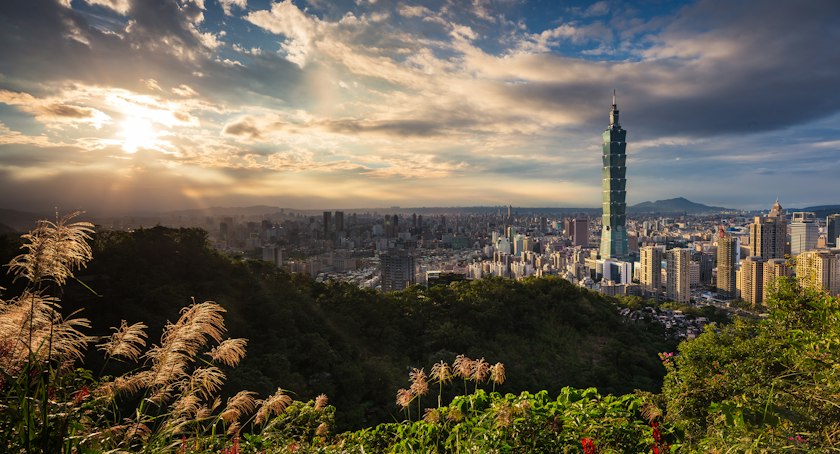
Taiwan's tourism bureau funded prayer rooms at transport hubs and major attractions as a deliberate policy. Very few non-Muslim-majority countries have done this systematically.
| Where | Prayer facilities |
|---|---|
| Taoyuan International Airport | Prayer rooms in both terminals, airside and landside, with ablution facilities, plus halal-certified restaurants. |
| Taipei Main Station | A dedicated prayer room in the station, installed under the tourism bureau's Muslim-friendly programme. |
| Major attractions | The National Palace Museum, Taipei 101, Sun Moon Lake visitor centre, Kenting, Alishan and several other sites have prayer rooms. |
| Mosques | Taipei Grand Mosque, Longgang, Taichung, Kaohsiung, Tainan and Hualien. All welcome visitors and all have ablution facilities. |
| Department stores and malls | Several major stores in Taipei and Taichung have added prayer rooms, usually on the upper floors. |
| High-speed rail stations | Some HSR stations have prayer rooms or quiet rooms; the tourism bureau publishes a current list. |
| Muslim-friendly hotels | Certified hotels provide qibla markers, prayer mats and sometimes a dedicated prayer room, under a standardised national rating. |
Taipei's Da'an and Zhongzheng districts put you near the Grand Mosque and the halal restaurants. Outside Taipei, look for hotels with the national Muslim-friendly certification.
Around the Taipei Grand Mosque and Da'an Forest Park, with the densest halal restaurant cluster in Taiwan on Xinsheng South Road. On the metro.
Central, with the station's prayer room, the Indonesian shops nearby and connections to the whole island. Practical rather than pretty.
The pedestrian shopping and youth district, busy and cheap, with good metro links.
Around Taipei 101, with the malls, the certified halal restaurant and the prayer room in the tower. More expensive.
The base for Taroko Gorge and the Qingshui Cliffs, with a small mosque and a few Muslim-friendly hotels.
Several lakeside hotels hold Muslim-friendly certification and serve halal breakfast, with the visitor centre prayer room nearby.
Guesthouses in the lantern-lit lanes, which are a completely different place once the day visitors leave.
Ninety minutes by high-speed rail, with a mosque, a harbour, the Lotus Pond temples and access to Kenting's beaches.
Good value by East Asian standards - cheaper than Japan or Singapore and comparable with Malaysia for food. All figures are per person per day unless stated, excluding international flights.
| Item | Budget | Mid-range | Premium |
|---|---|---|---|
| Accommodation | TWD 1,200-2,000 | TWD 3,000-5,000 | TWD 12,000+ |
| Food (3 meals) | TWD 400-700 | TWD 1,000-1,800 | TWD 4,000+ |
| Local transport | TWD 100-200 (metro) | TWD 400-800 | TWD 5,000 (car and driver) |
| Attractions | TWD 0-350 | TWD 600-1,200 | TWD 3,000+ |
| High-speed rail (Taipei-Kaohsiung) | TWD 1,490 (standard) | TWD 1,490 | TWD 2,000 (business) |
| Daily total per person | TWD 1,800-2,900 | TWD 4,500-8,000 | TWD 20,000+ |
Subtropical in the north and tropical in the south, with a typhoon season in late summer and mountains that are genuinely cold in winter.
| Period | Weather | Verdict for a halal trip |
|---|---|---|
| October-December | 18-27C, dry | The best window. Warm, dry, clear, and the mountains are at their best. Peak season, though Taiwan is rarely crowded. |
| January-March | 13-22C, damp in the north | Cool and often drizzly in Taipei, warmer in the south. Cherry blossom in February and March in the hills around Taipei. |
| April-June | 22-30C, plum rains | Warming, with the plum rain season in May and June bringing sustained wet spells. Still workable. |
| July-September | 28-35C, typhoons | Hot, humid and the typhoon season. Flights and trains cancel, mountain roads close. Cheapest, and the south is still good between storms. |
The questions Muslim travellers ask most often before booking.