South African Islam has a specific and remarkable history. Muslims arrived at the Cape from 1658 as slaves and political exiles from the Dutch East Indies - Sheikh Yusuf of Makassar, exiled here in 1694, is a national hero in both South Africa and Indonesia. Their descendants, the Cape Malay community, built the Bo-Kaap and the Auwal Mosque of 1794, the oldest in sub-Saharan Africa. Durban then acquired the largest Indian population outside India. The result is a country with excellent halal food, a strong certification system and world-class safari - at prices that make it one of the best-value destinations here.
Around 1.6% of South Africans are Muslim - roughly a million people - but concentrated in Cape Town and Durban, where the proportion is far higher. SANHA and the MJC run well-established halal certification.
The Auwal Mosque in the Bo-Kaap, founded in 1794 by Tuan Guru, a Tidore prince exiled to Robben Island, who wrote out the Qur'an from memory while imprisoned there. That manuscript survives.
Two distinct halal culinary traditions - Cape Malay bobotie, denningvleis and koeksisters, and Durban's bunny chow and breyani. Both are exceptional and both are cheap.
Kruger and the private reserves have lodges that cater specifically to Muslim guests, and several are Muslim-owned. Big Five game viewing with halal catering arranged in advance.
A quarter of brightly painted houses on the slope of Signal Hill, settled by freed slaves and Muslim exiles, with the oldest mosques in the country and a museum in an 18th-century house.
SANHA and MJC certification is on supermarket products, fast food chains, hotels and restaurants. South Africa has one of the best-developed halal systems outside the Muslim world.
A weak rand means a superb meal is ZAR 150-350, a good Cape Town hotel ZAR 1,200-2,500, and safari costs a fraction of East Africa's.
Four days in Cape Town for the Bo-Kaap and the peninsula, three on safari, three in Durban for the Indian quarter and the coast. Two internal flights.
Auwal Mosque - Bo-Kaap Museum - Company's Garden
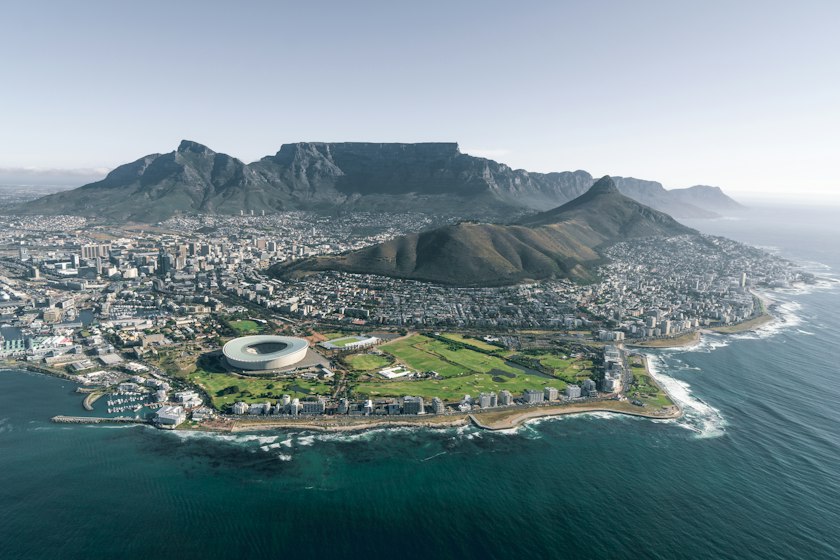
Table Mountain - V&A Waterfront - Robben Island
Chapman's Peak - Cape Point - Boulders Beach
Sheikh Yusuf kramat - Macassar - Stellenbosch
Johannesburg or Nelspruit - private reserve
Morning and evening game drives
Blyde River Canyon - God's Window - Bourke's Luck
Juma Masjid - Victoria Street Market - Grey Street
Golden Mile - uShaka - Umhlanga
Nizamiye Mosque - Soweto - Apartheid Museum
South Africa has over 500 mosques, the oldest in the Bo-Kaap. The kramats - tombs of the early Muslim exiles and leaders - form a circle around the Cape peninsula and are the country's distinctive ziyarah tradition.
Founded by Tuan Guru, a prince of Tidore exiled to Robben Island in 1780, who wrote out the Qur'an from memory in prison. The manuscript survives. The mosque has been in continuous use since.
The tomb of Sheikh Yusuf of Makassar, exiled to the Cape in 1694 after leading resistance to the Dutch in Banten. A national hero in both South Africa and Indonesia, and the most important Muslim site in the country.
Begun in 1881 and repeatedly expanded, holding several thousand, at the centre of Durban's Indian quarter. Guided visits can be arranged.
Built by a Turkish philanthropist as a scaled replica of Sinan's Selimiye Mosque in Edirne, opened in 2012. The largest mosque complex in the southern hemisphere, with a school, clinic and shops.
The second-oldest mosque in South Africa, in a converted house on Long Street with two palm trees outside, one of which survives.
One of several historic Bo-Kaap mosques within a few streets of each other, reflecting the quarter's density of congregations.
A ring of some twenty tombs of early Muslim exiles and leaders around the Cape peninsula - at Signal Hill, Oudekraal, Constantia, Faure and Robben Island. Cape Muslims traditionally visit them as a circuit.
One of the largest mosques in Cape Town, in the Cape Flats, serving a substantial community outside the historic Bo-Kaap.
Several mosques within the historic Indian commercial quarter around Juma Masjid, serving different community traditions.
Johannesburg's Muslim community spans Indian South African, Malawian, Somali and a growing number of Black South African converts, with mosques across Fordsburg, Lenasia and Soweto.
A Chishti Sufi complex in Rylands with a distinctive Indo-Islamic design, reflecting the other strand of South African Islam - South Asian rather than Southeast Asian.
One of several large Durban mosques serving the city's substantial Indian Muslim population.
Painted houses on the slope of Signal Hill, settled from the 18th century by freed slaves and exiles from the Indonesian archipelago. The oldest mosques in the country and a museum in an 18th-century house.
The oldest Muslim cemetery in South Africa, above the Bo-Kaap, where Tuan Guru and the early imams are buried. Closed to new burials in 1886, which provoked a significant protest.
Mandela's prison, and two centuries earlier the place of imprisonment for Muslim political exiles from the Dutch East Indies, including Tuan Guru. Tours led by former political prisoners.
The commercial heart of the largest Indian community outside India - spice merchants, fabric shops and the Juma Masjid, dating from the indentured labour migrations after 1860.
Outstanding and difficult - the history of segregation and its dismantling, including the role of Muslim activists in the struggle. Allow three hours.
Johannesburg's historic Indian and Muslim district, with the Oriental Plaza, a nightly street food market on Mint Road, and a history as a site of anti-apartheid organising.
Two distinct halal traditions - Cape Malay in the Western Cape, Indian in Durban and Johannesburg - plus SANHA and MJC certification across supermarkets and chains. South Africa is one of the easiest non-Muslim-majority countries in the world for halal food.
A hollowed quarter loaf of white bread filled with curry, invented in Durban by Indian workers who needed portable lunches. Eaten with your hands, and the bread lid used to scoop. Mutton is the classic.
Spiced minced meat with dried fruit under a baked egg custard, served with yellow rice. The Cape Malay dish, and arguably South Africa's national one.
A Cape Malay lamb stew sweetened with tamarind and studded with allspice - a direct descendant of a dish from the Indonesian archipelago.
Durban's version of biryani, layered with lentils and potato and spiced differently from the Indian original. Sunday food.
Two versions exist: the Cape Malay koesister is a spiced, syrup-soaked doughnut rolled in coconut; the Afrikaans koeksister is a plaited, glassy-syrup one. The Cape Malay version is the Sunday morning tradition.
Triangular fried pastries with mince, chicken or vegetable filling, made across both communities and sold everywhere. Spelled with the double 'o' in South Africa.
A Cape Town invention - a long roll stuffed with chips, masala steak or polony and sauce, cut into portions and shared. Deeply unhealthy and a genuine institution.
Skewered marinated lamb with dried apricots, grilled over coals - the word comes from the Malay 'sate'. Braai food.
The South African barbecue, and a social institution. Halal braai meat - boerewors, sosaties, lamb chops - is sold at every certified butcher.
A sticky apricot sponge served hot with custard. Traditionally contains apricot jam and vinegar; check for alcohol in some restaurant versions.
Red bush tea from the Cederberg, caffeine-free and grown nowhere else on earth. Drunk constantly and worth taking home.
Air-dried spiced beef and sausage, the national snack. Halal-certified versions are widely available at certified butchers and supermarkets.
A Bo-Kaap institution serving Cape Malay food - bobotie, denningvleis, curries and koeksisters - in the heart of the painted quarter. Family-run for decades.
Cape Malay cooking with a terrace looking over the city to Table Mountain. Book for the view as much as the food.
Not a restaurant but a spice merchant open since 1946, where the Bo-Kaap buys its masalas. The place to understand Cape Malay cooking.
Gatsbys, curries and Cape Malay staples in the city centre, cheap and consistently busy at lunchtime.
Several Bo-Kaap families run half-day classes in their homes - the market, then bobotie, roti and koeksisters. The best single thing to do in Cape Town for a food traveller.
A long-established Durban curry house serving breyani and the city's signature dishes near the Grey Street quarter.
Durban curry done straightforwardly, with bunny chow among the options. Local rather than touristy.
A South African halal chain doing Durban-style curries and bunny chow, with branches in both cities. Reliable.
Spice merchants and cooked food stalls in the covered market at the heart of the Indian quarter.
Mint Road fills with food stalls most evenings - grilled meat, samoosas, falooda, curries. The best halal street food in Johannesburg.
A large covered shopping and eating complex in Johannesburg's Indian quarter, with dozens of halal food outlets.
The coastal suburb north of Durban has a substantial Muslim community and a good cluster of halal restaurants along the promenade and in the malls.
Several Kruger-area lodges are Muslim-owned or arrange halal catering with advance notice, along with prayer facilities. Book the catering when you book the room.
Nando's, Steers, KFC and several other national chains have SANHA or MJC-certified branches, clearly marked. Useful on road trips.
Over 500 mosques, concentrated in the Western Cape, KwaZulu-Natal and Gauteng. Prayer facilities are common in malls and at airports in those provinces.
| Where | Prayer facilities |
|---|---|
| Cape Town and OR Tambo airports | Prayer rooms at both, with ablution facilities. Durban's King Shaka also has one. |
| Shopping malls | Malls in Cape Town, Durban and Johannesburg commonly have prayer rooms, particularly in areas with Muslim populations - Canal Walk, Gateway and Sandton City among them. |
| Bo-Kaap | Several mosques within a few streets, all open for the five prayers, in the heart of the historic quarter. |
| Durban Grey Street quarter | Juma Masjid and several other mosques within the Indian commercial district. |
| Safari lodges | Lodges catering to Muslim guests provide prayer space and qibla direction; arrange when booking. |
| Hotels | Qibla markers are common in Cape Town and Durban hotels used to Muslim guests. Elsewhere, ask. |
| The kramats | Most of the Cape peninsula kramats have a small prayer space attached and are visited as a circuit by Cape Muslims. |
In Cape Town, the Bo-Kaap and the City Bowl put you near the mosques and Cape Malay food. In Durban, Umhlanga has the largest Muslim community and the best beach.
Guesthouses in the painted quarter itself, with the historic mosques, the Cape Malay restaurants and Table Mountain above. Central and walkable in daylight.
Secure, walkable, with halal-certified restaurants, the Robben Island ferry and the Zeitz MOCAA. More expensive and less characterful.
On the Atlantic seaboard with a long promenade, a good restaurant scene and a substantial Muslim community nearby in Rylands and Gatesville.
North of Durban, with a large Muslim community, halal restaurants, warm-sea beaches and a lighthouse promenade. Safer and calmer than central Durban.
The beachfront hotels, close to the Indian quarter and uShaka. Exercise normal caution after dark.
Sabi Sand, Timbavati and the Kruger-area lodges, several of which are Muslim-owned or arrange halal catering and prayer space on request.
Fordsburg for the halal food and the night market; Sandton for security and business hotels, with halal options in the malls.
Cape Dutch architecture in mountain valleys an hour from Cape Town. Halal food is thin here - plan to eat in Cape Town or self-cater.
The best value destination in this guide after Egypt - a weak rand goes a long way. All figures are per person per day unless stated, excluding international flights.
| Item | Budget | Mid-range | Premium |
|---|---|---|---|
| Accommodation | ZAR 700-1,200 | ZAR 1,800-3,500 | ZAR 9,000+ |
| Food (3 meals) | ZAR 250-450 | ZAR 600-1,100 | ZAR 2,500+ |
| Car hire per day | ZAR 400-600 | ZAR 700-1,100 | ZAR 3,000 (with driver) |
| Attractions | ZAR 150-400 | ZAR 600-1,200 | ZAR 3,000+ |
| Safari lodge per night (pp) | ZAR 1,800-3,000 | ZAR 4,500-8,000 | ZAR 20,000+ |
| Daily total per person | ZAR 1,200-2,000 | ZAR 3,000-5,500 | ZAR 18,000+ |
Southern hemisphere seasons, and the Cape and the safari areas have opposite best seasons.
| Period | Weather | Verdict for a halal trip |
|---|---|---|
| October-April | 20-30C in the Cape | Cape Town's summer - warm, dry, long days, and the best time for the peninsula and the winelands. Peak prices over Christmas and January. |
| May-September | 10-20C in the Cape, dry in Kruger | The best safari season - the bush thins out, animals gather at waterholes and malaria risk drops. Cape Town is wet and cold. |
| March-May | Mild everywhere | A good compromise - autumn in the Cape with fewer visitors, and the safari season beginning. Whale watching at Hermanus runs June to November. |
| Durban, year-round | 22-30C | Subtropical and warm all year. Summer (December to March) is hot and humid with afternoon storms; winter is dry and perfect. |
The questions Muslim travellers ask most often before booking.