Arab traders reached Sri Lanka in the eighth century and their descendants, the Sri Lankan Moors, are around a tenth of the population today. That gives the island a genuinely easy halal food scene - beef is eaten, pork is rare, and Muslim-run restaurants are everywhere. It also has Adam's Peak, the mountain that Muslim tradition identifies as the place Adam first set foot on earth after leaving Paradise, with a footprint at the summit venerated by Muslims, Buddhists, Hindus and Christians alike. Add tea country, Dutch colonial Galle and some of Asia's best beaches, at very low prices.
Around 10% of Sri Lankans are Muslim, mostly Sri Lankan Moors descended from Arab traders, plus Malay and Indian Muslim communities. Halal food is widely available and Sri Lankan cuisine is naturally accommodating.
A 2,243-metre peak with a rock depression at the summit venerated by four religions. Muslim tradition identifies it as the place Adam first set foot on earth, standing on one leg in penance. The night climb to see sunrise is one of Asia's great pilgrimages.
Arab traders reached the island in the eighth century. The Kechimalai Mosque at Beruwala stands on the headland where they are said to have landed, and Colombo's candy-striped Red Mosque of 1908 is the country's most photographed building after the rock at Sigiriya.
Pork is rare in Sri Lankan cooking, beef is eaten, and Muslim-run 'hotels' - which means restaurants here - are everywhere. Kottu roti, biryani, hoppers and watalappan are all easy.
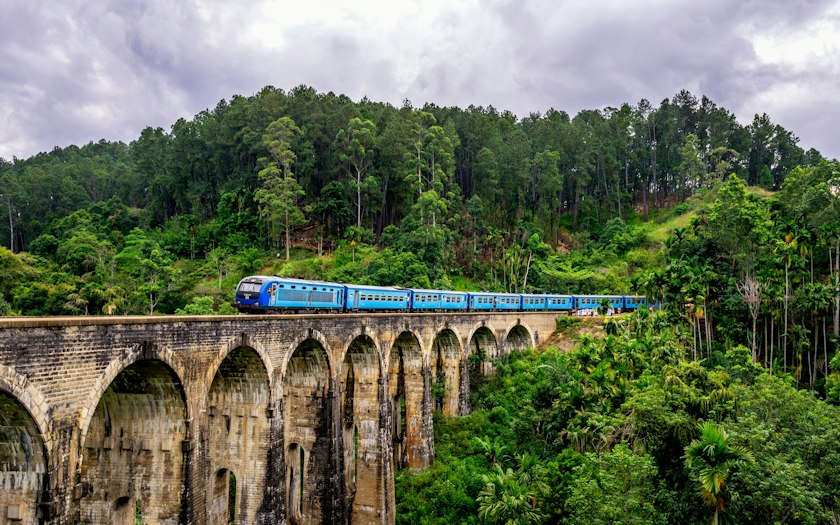
Seven hours through tea plantations, waterfalls and cloud forest, routinely called one of the most beautiful rail journeys in the world. It costs a couple of dollars.
The south and west from December to March, the east from April to September. Arugam Bay, Mirissa, Trincomalee and the Muslim-majority coastal towns of the east.
A rice and curry lunch is LKR 400-900, a good guesthouse LKR 5,000-12,000, and the trains cost pennies. One of the best-value destinations anywhere.
Colombo and the west coast, up through the Cultural Triangle to Kandy and tea country, Adam's Peak in season, then down to Galle and the southern beaches.
Red Mosque - Pettah - Galle Face
Kechimalai Mosque - Bentota - Ambalangoda
Sigiriya - Dambulla
Ancient capitals
Temple of the Tooth - Meera Makam Mosque - lake
Kandy - Nuwara Eliya - Ella
Dalhousie - Sri Pada summit
Galle Fort - Meeran Jumma Masjid
Mirissa - Weligama - whale watching
Colombo - or Arugam Bay
Sri Lanka has around 5,000 mosques, concentrated in Colombo, the west coast and the east. The Moor community's mosques are often architecturally distinctive - neither Indian nor Arab but something local.
A 2,243-metre peak with a rock depression at the summit. Muslim tradition identifies it as the place Adam first set foot on earth after leaving Paradise, standing in penance on one leg. Venerated equally by Buddhists, Hindus and Christians. Climbing season December to May.
Candy-striped red and white brick with onion domes and a design found nowhere else, built by Colombo's Indian Muslim traders in 1908. The most photographed mosque in Sri Lanka and the landmark of the Pettah bazaar.
On a headland above the sea where Arab traders are said to have landed in the eighth century, making it traditionally the oldest Muslim site in Sri Lanka. Its annual festival draws pilgrims from across the island.
Built around the shrine of a Sufi saint, in the middle of colonial Colombo, and an active site of visitation for the city's Muslim community.
A white mosque inside the Dutch-built UNESCO fort, facing the sea beside the lighthouse, with a facade that could be mistaken for a church. Much of the fort's residential population is Muslim.
Serving Kandy's long-established Muslim community, a short walk from the Temple of the Tooth - a reminder of how long the two communities have shared the town.
Kattankudy is one of the most densely Muslim towns in Sri Lanka, with dozens of mosques in a few square kilometres and a distinctive local architecture.
The principal congregational mosque of the capital, near the Pettah market district.
One of the largest mosques in the Colombo area, serving the southern suburbs.
The southern coastal towns have long-established Muslim fishing and trading communities with mosques facing the sea.
The only mountain on earth sacred to Buddhists, Hindus, Muslims and Christians simultaneously, each identifying the summit footprint differently. The night climb and the triangular shadow at sunrise are the experience.
A Dutch walled town on a promontory, built over a Portuguese fort, with ramparts you can walk right around, a lighthouse, and a mosque inside the walls. Much of the residential population is Muslim.
A dense grid of streets, each traditionally selling one category of goods, around the Red Mosque. Colombo's commercial heart and historically its Muslim trading quarter.
A fifth-century palace on top of a 200-metre granite column, with frescoes of court women halfway up and a gateway of lion's paws. The single most spectacular site on the island.
The Kechimalai Mosque on the headland marks where Arab traders are traditionally held to have landed in the eighth century, beginning thirteen centuries of Muslim settlement.
The island's main museum, covering the Sinhalese kingdoms, the colonial period and the communities of the island including the Moors and Malays.
One of the easiest non-Muslim-majority countries for halal food. Pork is rare in Sri Lankan cooking, beef is eaten, and Muslim-run restaurants - called 'hotels' here - are on every main street.
Godamba roti chopped on a hot plate with vegetables, egg and meat, to a rhythmic clanging of metal blades that you hear before you see it. Sri Lanka's national street food and usually made at Muslim-run shops.
Rice with five to ten small curries - dhal, jackfruit, beetroot, okra, fish or chicken - plus pol sambol and papadum. The everyday lunch, and enormously good value.
Bowl-shaped fermented rice-flour pancakes, crisp at the edge and soft in the middle, often with an egg cooked into the base. Breakfast and dinner food.
Steamed nests of rice-flour noodles, eaten with dhal and coconut sambol. The other Sri Lankan breakfast.
Distinct from the Indian versions - a Moor and Malay dish, with a lighter spicing and served with a boiled egg and a hot sambol. The Sunday meal in Muslim households.
A steamed coconut milk and jaggery custard with cardamom and cashew, of Sri Lankan Malay origin and served at every Muslim celebration. The island's best dessert.
Grated coconut pounded with chilli, lime, onion and Maldive fish. Eaten with everything, and the flavour most people miss when they leave.
Sour fish curry from the south, cooked dry with goraka, a tamarind-like fruit that acts as a preservative. Intense and specifically Sri Lankan.
Fried savouries sold from glass cabinets in every tea shop - fish buns, mutton rolls, vadai, cutlets. A few rupees each and the backbone of Sri Lankan snacking.
Rice, meat, sambol and a fried egg baked in a banana leaf - a Dutch Burgher dish, and the Muslim versions use beef or chicken.
Grown in the hill country since the 1860s and drunk constantly, strong and with condensed milk in the local style.
King coconut (thambili) drunk from the shell, plus rambutan, mangosteen, wood apple and jackfruit. Sold from roadside stalls everywhere.
A Colombo institution open into the small hours, famous for kottu roti and cheese kottu in particular. Several branches; the Galle Road one is the original.
Serving Muslim Sri Lankan food since the 1930s - biryani, mutton curry and fried rice - in the heart of Colombo. One of the oldest restaurants in the country.
Short eats, kottu and biryani from the shops around the Red Mosque, in a district that has been the Muslim trading quarter for generations.
In Sri Lanka a 'hotel' usually means a small restaurant. Muslim-run ones are on every main street, serve beef and chicken, and are the reliable everyday option across the island.
Largely Muslim towns with seafood, biryani and short eats at local prices, near the Kechimalai Mosque.
The fort has a mix of tourist restaurants and local shops. Lucky Fort Restaurant serves a well-known rice and curry; several fort establishments are Muslim-run.
Long-running halal restaurant near the lake serving biryani, kottu and rice and curry to Kandy's Muslim community.
Tea estate rooms and colonial hotels serve tea and cake; for meals, the town's Muslim-run shops are the better bet.
The eastern Muslim towns have their own food culture, closer to South Indian Muslim cooking, and almost every restaurant is halal.
Beachfront restaurants grilling the day's catch. Fish is straightforward; ask about meat dishes and check for pork at the tourist-oriented places.
Trincomalee has a substantial Muslim population and its restaurants reflect it, with biryani and seafood at very low prices.
Glass cabinets of fish buns, mutton rolls, cutlets and vadai in every tea shop and bakery, for a few rupees each. Overwhelmingly beef, chicken or fish.
Steamed coconut and jaggery custard, plus Malay and Moor sweets, made for celebrations and sold year-round at Muslim bakeries.
Beach resorts serve pork and alcohol for European guests but will usually arrange halal meals on request - ask when booking.
Around 5,000 mosques across the island, with the densest provision in Colombo, the west coast and the east. Prayer is easy almost everywhere except the deep hill country.
| Where | Prayer facilities |
|---|---|
| Bandaranaike International Airport | A prayer room in the terminal with ablution facilities. |
| Colombo | Dozens of mosques including the Red Mosque in Pettah, the Grand Mosque and Dewatagaha. Prayer is never a problem in the capital. |
| West coast | Beruwala, Aluthgama, Kalutara and Negombo all have substantial Muslim populations and mosques on the main roads. |
| Eastern province | Kattankudy, Kalmunai, Oluvil and Trincomalee are heavily Muslim, with mosques every few hundred metres. |
| Adam's Peak | The summit is a shared sacred space for four religions and pilgrims of all of them pray there. There are rest stops with facilities along the climbing route during the season. |
| Kandy and the hills | Kandy has several mosques near the lake; the tea country towns have fewer, so plan around them. |
| Hotels and guesthouses | Qibla direction is generally known and mats are supplied on request. Sri Lankan hospitality makes this straightforward to ask about. |
Sri Lanka's accommodation is mostly small guesthouses and boutique villas rather than chain hotels, which makes it both cheap and personal.
The seafront and the colonial core, walkable to Pettah and the Red Mosque, with the widest hotel choice in the country.
A beach suburb south of the capital, cheaper than the centre, with a substantial Muslim community and good local restaurants.
Largely Muslim coastal towns with the historic Kechimalai Mosque, beaches and halal food as the default. An hour and a half from Colombo.
For Sigiriya, Dambulla, Polonnaruwa and the national parks. Everything from village homestays to safari-style lodges.
In a bowl of hills around the lake, with the Temple of the Tooth, the botanic gardens and mosques near the centre.
Small hill towns at 1,000-1,400 metres with tea estates, waterfalls and viewpoints. Cool at night and beautiful.
Boutique guesthouses in Dutch colonial houses inside the UNESCO walls, with the mosque and the ramparts on the doorstep.
The southern beach strip, busy from December to March. Unawatuna is calmest; Mirissa has the whale watching; Weligama the surfing.
One of the cheapest destinations in this guide, with a weak rupee and a strong guesthouse culture. All figures are per person per day unless stated, excluding international flights.
| Item | Budget | Mid-range | Premium |
|---|---|---|---|
| Accommodation | LKR 4,000-8,000 | LKR 12,000-25,000 | LKR 70,000+ |
| Food (3 meals) | LKR 1,500-2,800 | LKR 4,500-8,000 | LKR 20,000+ |
| Car with driver per day | LKR 10,000-13,000 | LKR 14,000-18,000 | LKR 30,000+ |
| Attractions | LKR 1,500-4,000 | LKR 6,000-12,000 (Sigiriya) | LKR 30,000+ |
| Safari (half day, pp) | LKR 8,000-12,000 | LKR 15,000-22,000 | LKR 45,000+ |
| Daily total per person | LKR 8,000-14,000 | LKR 22,000-40,000 | LKR 120,000+ |
Two monsoons on opposite cycles, which means somewhere on the island is always in season.
| Period | Weather | Verdict for a halal trip |
|---|---|---|
| December-March | 26-32C, dry in the west and south | The main season - Colombo, Galle, the south coast beaches and the Cultural Triangle. Peak prices over Christmas and New Year. |
| April-September | 26-33C, dry in the east and north | The east coast season - Trincomalee, Arugam Bay and Batticaloa, with empty beaches and world-class surf. The southwest is wet. |
| December-May | Cool and clear at altitude | Adam's Peak season, when the path is lit and the facilities open. The full moon nights in this window are the busiest. |
| October-November | Inter-monsoon, wet everywhere | The one period when both coasts are unreliable. Cheapest, greenest, and with afternoon downpours across the island. |
The questions Muslim travellers ask most often before booking.